Portugal's New Citizenship Rules: Where Things Stand
30th September 2026

Most articles about Portugal's 2026 nationality reform focus on one point: the wait for a Portuguese passport has doubled. This is mostly true, but coverage usually ends there.
Two important points are often overlooked.
First, the Golden Visa programme itself was not changed at all. The thresholds, stay requirements, family inclusion, and permanent residency rules all remain the same. Also, more than four months after the law took effect, the Government still has not published the regulations needed to put much of it into practice.
Here is where things currently stand.
What the law changed
Parliament approved Lei Orgânica n.º 1/2026 on 1 April 2026; President António José Seguro promulgated it on 3 May, published it in the Diário da República on 18 May, and it came into force on 19 May 2026.
Two changes matter most.
The qualifying period
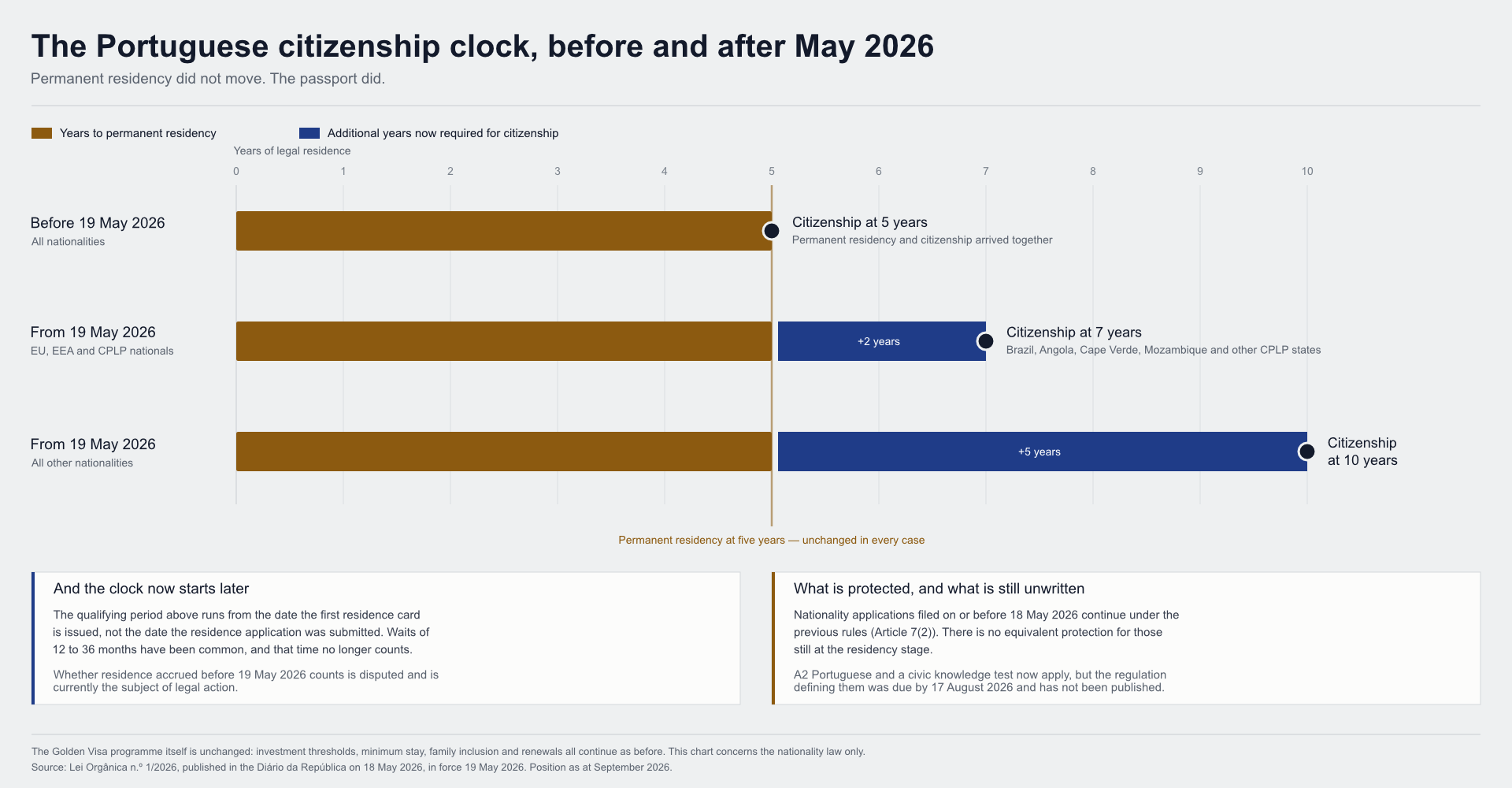
Before, naturalisation by residence required five years of legal residence for everyone. Now, it takes seven years for nationals of EU and EEA member states and CPLP countries such as Brazil, Angola, Mozambique, Cape Verde, Guinea-Bissau, São Tomé and Príncipe, and Timor-Leste. For everyone else, it takes ten years.
When the clock starts
This change has had the biggest impact, but it is rarely discussed. Now, the qualifying period starts from the date the first residence card is issued, which is the date printed on the card, instead of the date the residence application was submitted.
For people stuck in AIMA's backlog, this change can be costly. Waiting twelve to thirty-six months between applying and getting a card has been common. Under the old rules, that waiting time usually counted. Now, it does not.
The reform also removed the Sephardic descent route, created a path for great-grandchildren of Portuguese citizens if they can prove a real connection, and made the rules stricter for children born in Portugal to foreign parents.
Now, these children need a parent who has lived legally in Portugal for at least five years at the time of birth, plus an express declaration.
Who is protected, and who is not
Article 7(2) protects administrative procedures already pending when the law took effect. In practice: nationality applications filed on or before 18 May 2026 continue under the previous rules. If your application was in, you are fine.
The problem is for everyone else.
The law does not include a broad transitional regime for people still at the residency stage. For example, an investor who joined the Golden Visa in 2022 expecting a five-year path to citizenship, but who had not yet filed a nationality application, often because AIMA had not issued their residence card, gets no protection at all.
Even worse, the statute does not say whether residence time earned before 19 May 2026 counts toward the new timeline. This question is still unresolved and is now the subject of legal action.
The regulation that never came
Article 4 of the law obliged the Government to update the Regulamento da Nacionalidade — the implementing regulation, Decree-Law n.º 237-A/2006 — within 90 days of publication. That deadline fell on or about 17 August 2026.
The deadline passed with nothing published. So far, neither AIMA nor the Institute of Registries and Notaries has issued any procedural guidance.
As a result, the law is in force, but many of its details remain undefined. Several requirements are in the statute but cannot be applied yet because the rules for them have not been written:
The A2-level Portuguese language requirement and how it is assessed
The civic and cultural knowledge test — its form, content, and pass standard
The evidentiary standard for proving an effective connection to the national community, which the new great-grandchildren route depends on
How the new residency clock is verified in practice
One common belief needs to be corrected, as it is spreading widely: the regulation is unlikely to resolve the accrued-residence question. That silence is in the main law, and the Regulamento is secondary.
A decree-law can set procedures, but it cannot easily create or remove rights that the main law did not address. If it tried, the result could be challenged. Portugal has a history of this: a part of the current Regulamento, introduced by decree-law in 2022, was later declared illegal with general binding force.
It now seems more likely that the courts or a change in the law will settle the accrual question, rather than the regulation everyone is waiting for. Anyone hoping the Regulamento will resolve their situation should expect to wait longer.
This is not just a technical detail. For some applicants, nobody, including the authorities, can yet say exactly what will be required or how it will be measured.
The legal challenge
The reaction has gone well beyond commentary.
A group of nine Portuguese law firms filed a complaint with the Ombudsman on behalf of 1,260 Golden Visa investors, and the number could rise to 2,000.
The complaint targets both the legislative change and what the firms describe as years of administrative failure at AIMA. It asks the Ombudsman to protect the legitimate expectations of applicants who organised their lives around the framework Portugal promoted.
Separately, a group of more than 500 holders, mostly American investors, has been organising collective action against the Portuguese state. They argue that a state agency's own backlog is now being used to extend how long they must wait.
Investors have also taken the matter to the Constitutional Court, arguing that the absence of a transitional regime offends segurança jurídica, or legal certainty, and tutela da confiança, which means the protection of legitimate expectations.
Both are established principles of Portuguese constitutional law. The Court has already shown willingness to intervene in this area. It struck down parts of the reform's first version in December 2025, which is why Parliament had to redraft.
The President also made a notable remark. When signing the law, Seguro said that the counting of nationality deadlines "should not be affected by the slowness of the State." This is not a ruling and does not bind anyone, but it is a direct acknowledgement of the problem from the person who signed the law, and it is being cited.
A related argument is circulating among practitioners. Since Portuguese administrative law requires a decision on a residence permit application within 90 days, some say the citizenship clock should start on day 91 after submission, not when AIMA actually issues the card.
This idea is untested. No authority has adopted it, and no court has ruled on it. Consider it an argument you can try, but not one you can rely on.
What did not change
It's worth stating clearly, since headlines have often missed this point.
The Golden Visa is governed by immigration law, a separate framework from nationality law, and it was not amended. Unchanged:
Investment thresholds and qualifying routes
The minimal physical stay requirement
Family inclusion
Renewal rules
Permanent residency after five years of legal residence
That last point deserves more attention. The route to permanent residency in Portugal is unchanged and still takes five years. What has changed is the longer wait for a passport.
AIMA's processing has also improved in 2026, with the agency working to clear the Golden Visa backlog by year-end. This has two effects: faster card issuance starts the clock sooner, which matters more under the new rules than before.
What this means in practice
Portugal is now more of a long-term European residency option rather than a fast route to an EU passport.
For many investors, that is still exactly what they want: a stable EU base, minimal stay obligations, family coverage, and permanent residency on the original five-year timetable.
If your main goal was the passport itself, the calculation has changed. It is worth comparing Portugal honestly with other options before deciding.
If you are already in the Portuguese system at the residency stage, the practical question is simpler: what does your file show about when your first residence card was issued, and does this put you in the group affected by the unresolved accrual question?
It is better to find this out now rather than discover it later.
Where to go from here
The honest truth is that Portugal is in the middle of the process: the law is settled, but the implementing rules are not, and much litigation is still ongoing. This isn't a good time for assumptions, but it is a good time to check exactly where your file stands.
If you are considering Portugal now, or you are already in the system and are not sure which side of 18 May you fall on, this is the right time to talk about it.
Frequently asked questions
Did the Portugal Golden Visa change in 2026?
No, the 2026 reform changed the nationality law, not the immigration law for the Golden Visa. The investment thresholds, stay requirements, family inclusion, and renewal rules are the same. You can still get permanent residency after five years.
How long does Portuguese citizenship take now?
For EU, EEA, and CPLP nationals, it now takes seven years of legal residence. For everyone else, it takes ten years. The count starts from when your first residence card is issued.
Am I protected if I applied before the change?
If you filed your nationality application on or before 18 May 2026, your case will follow the previous rules under Article 7(2). However, this protection does not apply if you are still in the residency process.
Does the time I have already spent in Portugal count?
The law does not clearly answer this question, and there is ongoing debate. This issue is at the heart of a current legal case and has not been resolved yet. The upcoming regulation probably will not clarify it, since the main law itself is unclear.
Ready to get started?
Speak to our friendly team of experts today to learn more or to begin your journey.
Recommended for You

The Trump Gold Card, Nine Months In
7 October 2026

EU vs Caribbean Citizenship-by-Investment: What Changed in 2026
23 September 2026

EB-5 Grandfathering: The 30 September Deadline, Explained
16 September 2026

Latvia's Door Is Closing: The Question Is Whether You'll Walk Through It First
14 August 2026

Portugal Golden Visa: Important Update May 2026
27 May 2026

What’s Better: Trump’s Gold Card vs the EB-5 Visa?
16 January 2026

Portugal’s Golden Visa: What Three Years of Change Tell Global Citizens About 2026
17 December 2025

How Do H-1B Visa Changes Affect the EB-3 & EB-5 Visas?
26 September 2025

Double Tax Agreements: What are They and How Do They Work?
10 July 2025
Portugal's New Citizenship Rules: Where Things Stand
Published on: 30th September 2026
Most articles about Portugal's 2026 nationality reform focus on one point: the wait for a Portuguese passport has doubled. This is mostly true, but coverage usually ends there.
Two important points are often overlooked.
First, the Golden Visa programme itself was not changed at all. The thresholds, stay requirements, family inclusion, and permanent residency rules all remain the same. Also, more than four months after the law took effect, the Government still has not published the regulations needed to put much of it into practice.
Here is where things currently stand.
What the law changed
Parliament approved Lei Orgânica n.º 1/2026 on 1 April 2026; President António José Seguro promulgated it on 3 May, published it in the Diário da República on 18 May, and it came into force on 19 May 2026.
Two changes matter most.
The qualifying period
Before, naturalisation by residence required five years of legal residence for everyone. Now, it takes seven years for nationals of EU and EEA member states and CPLP countries such as Brazil, Angola, Mozambique, Cape Verde, Guinea-Bissau, São Tomé and Príncipe, and Timor-Leste. For everyone else, it takes ten years.
When the clock starts
This change has had the biggest impact, but it is rarely discussed. Now, the qualifying period starts from the date the first residence card is issued, which is the date printed on the card, instead of the date the residence application was submitted.
For people stuck in AIMA's backlog, this change can be costly. Waiting twelve to thirty-six months between applying and getting a card has been common. Under the old rules, that waiting time usually counted. Now, it does not.
The reform also removed the Sephardic descent route, created a path for great-grandchildren of Portuguese citizens if they can prove a real connection, and made the rules stricter for children born in Portugal to foreign parents.
Now, these children need a parent who has lived legally in Portugal for at least five years at the time of birth, plus an express declaration.
Who is protected, and who is not
Article 7(2) protects administrative procedures already pending when the law took effect. In practice: nationality applications filed on or before 18 May 2026 continue under the previous rules. If your application was in, you are fine.
The problem is for everyone else.
The law does not include a broad transitional regime for people still at the residency stage. For example, an investor who joined the Golden Visa in 2022 expecting a five-year path to citizenship, but who had not yet filed a nationality application, often because AIMA had not issued their residence card, gets no protection at all.
Even worse, the statute does not say whether residence time earned before 19 May 2026 counts toward the new timeline. This question is still unresolved and is now the subject of legal action.
The regulation that never came
Article 4 of the law obliged the Government to update the Regulamento da Nacionalidade — the implementing regulation, Decree-Law n.º 237-A/2006 — within 90 days of publication. That deadline fell on or about 17 August 2026.
The deadline passed with nothing published. So far, neither AIMA nor the Institute of Registries and Notaries has issued any procedural guidance.
As a result, the law is in force, but many of its details remain undefined. Several requirements are in the statute but cannot be applied yet because the rules for them have not been written:
The A2-level Portuguese language requirement and how it is assessed
The civic and cultural knowledge test — its form, content, and pass standard
The evidentiary standard for proving an effective connection to the national community, which the new great-grandchildren route depends on
How the new residency clock is verified in practice
One common belief needs to be corrected, as it is spreading widely: the regulation is unlikely to resolve the accrued-residence question. That silence is in the main law, and the Regulamento is secondary.
A decree-law can set procedures, but it cannot easily create or remove rights that the main law did not address. If it tried, the result could be challenged. Portugal has a history of this: a part of the current Regulamento, introduced by decree-law in 2022, was later declared illegal with general binding force.
It now seems more likely that the courts or a change in the law will settle the accrual question, rather than the regulation everyone is waiting for. Anyone hoping the Regulamento will resolve their situation should expect to wait longer.
This is not just a technical detail. For some applicants, nobody, including the authorities, can yet say exactly what will be required or how it will be measured.
The legal challenge
The reaction has gone well beyond commentary.
A group of nine Portuguese law firms filed a complaint with the Ombudsman on behalf of 1,260 Golden Visa investors, and the number could rise to 2,000.
The complaint targets both the legislative change and what the firms describe as years of administrative failure at AIMA. It asks the Ombudsman to protect the legitimate expectations of applicants who organised their lives around the framework Portugal promoted.
Separately, a group of more than 500 holders, mostly American investors, has been organising collective action against the Portuguese state. They argue that a state agency's own backlog is now being used to extend how long they must wait.
Investors have also taken the matter to the Constitutional Court, arguing that the absence of a transitional regime offends segurança jurídica, or legal certainty, and tutela da confiança, which means the protection of legitimate expectations.
Both are established principles of Portuguese constitutional law. The Court has already shown willingness to intervene in this area. It struck down parts of the reform's first version in December 2025, which is why Parliament had to redraft.
The President also made a notable remark. When signing the law, Seguro said that the counting of nationality deadlines "should not be affected by the slowness of the State." This is not a ruling and does not bind anyone, but it is a direct acknowledgement of the problem from the person who signed the law, and it is being cited.
A related argument is circulating among practitioners. Since Portuguese administrative law requires a decision on a residence permit application within 90 days, some say the citizenship clock should start on day 91 after submission, not when AIMA actually issues the card.
This idea is untested. No authority has adopted it, and no court has ruled on it. Consider it an argument you can try, but not one you can rely on.
What did not change
It's worth stating clearly, since headlines have often missed this point.
The Golden Visa is governed by immigration law, a separate framework from nationality law, and it was not amended. Unchanged:
Investment thresholds and qualifying routes
The minimal physical stay requirement
Family inclusion
Renewal rules
Permanent residency after five years of legal residence
That last point deserves more attention. The route to permanent residency in Portugal is unchanged and still takes five years. What has changed is the longer wait for a passport.
AIMA's processing has also improved in 2026, with the agency working to clear the Golden Visa backlog by year-end. This has two effects: faster card issuance starts the clock sooner, which matters more under the new rules than before.
What this means in practice
Portugal is now more of a long-term European residency option rather than a fast route to an EU passport.
For many investors, that is still exactly what they want: a stable EU base, minimal stay obligations, family coverage, and permanent residency on the original five-year timetable.
If your main goal was the passport itself, the calculation has changed. It is worth comparing Portugal honestly with other options before deciding.
If you are already in the Portuguese system at the residency stage, the practical question is simpler: what does your file show about when your first residence card was issued, and does this put you in the group affected by the unresolved accrual question?
It is better to find this out now rather than discover it later.
Where to go from here
The honest truth is that Portugal is in the middle of the process: the law is settled, but the implementing rules are not, and much litigation is still ongoing. This isn't a good time for assumptions, but it is a good time to check exactly where your file stands.
If you are considering Portugal now, or you are already in the system and are not sure which side of 18 May you fall on, this is the right time to talk about it.
Frequently asked questions
Did the Portugal Golden Visa change in 2026?
No, the 2026 reform changed the nationality law, not the immigration law for the Golden Visa. The investment thresholds, stay requirements, family inclusion, and renewal rules are the same. You can still get permanent residency after five years.
How long does Portuguese citizenship take now?
For EU, EEA, and CPLP nationals, it now takes seven years of legal residence. For everyone else, it takes ten years. The count starts from when your first residence card is issued.
Am I protected if I applied before the change?
If you filed your nationality application on or before 18 May 2026, your case will follow the previous rules under Article 7(2). However, this protection does not apply if you are still in the residency process.
Does the time I have already spent in Portugal count?
The law does not clearly answer this question, and there is ongoing debate. This issue is at the heart of a current legal case and has not been resolved yet. The upcoming regulation probably will not clarify it, since the main law itself is unclear.
Need professional financial advice?
We have 18 offices across the globe and we manage over $2billion for our 20,000+ clients