The Panama Qualified Investor Visa: What Changed and What Didn’t
22nd October 2026

Throughout this year, people researching Panamanian residency have heard the same message: the Qualified Investor property threshold will rise from $300,000 to $500,000 on 15 October 2026, so act now or pay $200,000 more later.
No official decree ever mentioned that deadline. The rules actually changed on 16 September 2026, which was a month earlier than expected.
The $300,000 entry point remains. The main change is which properties now qualify at that price point.
What Decree 17 actually did
Executive Decree No. 17, dated 8 September 2026, was published in Gaceta Oficial Digital No. 30613 on 16 September and took effect that same day. It replaces Executive Decree 722 of 2020 and all later amendments, bringing the entire Qualified Investor program under one set of rules.
Now, the real estate threshold depends on the property's sales history:
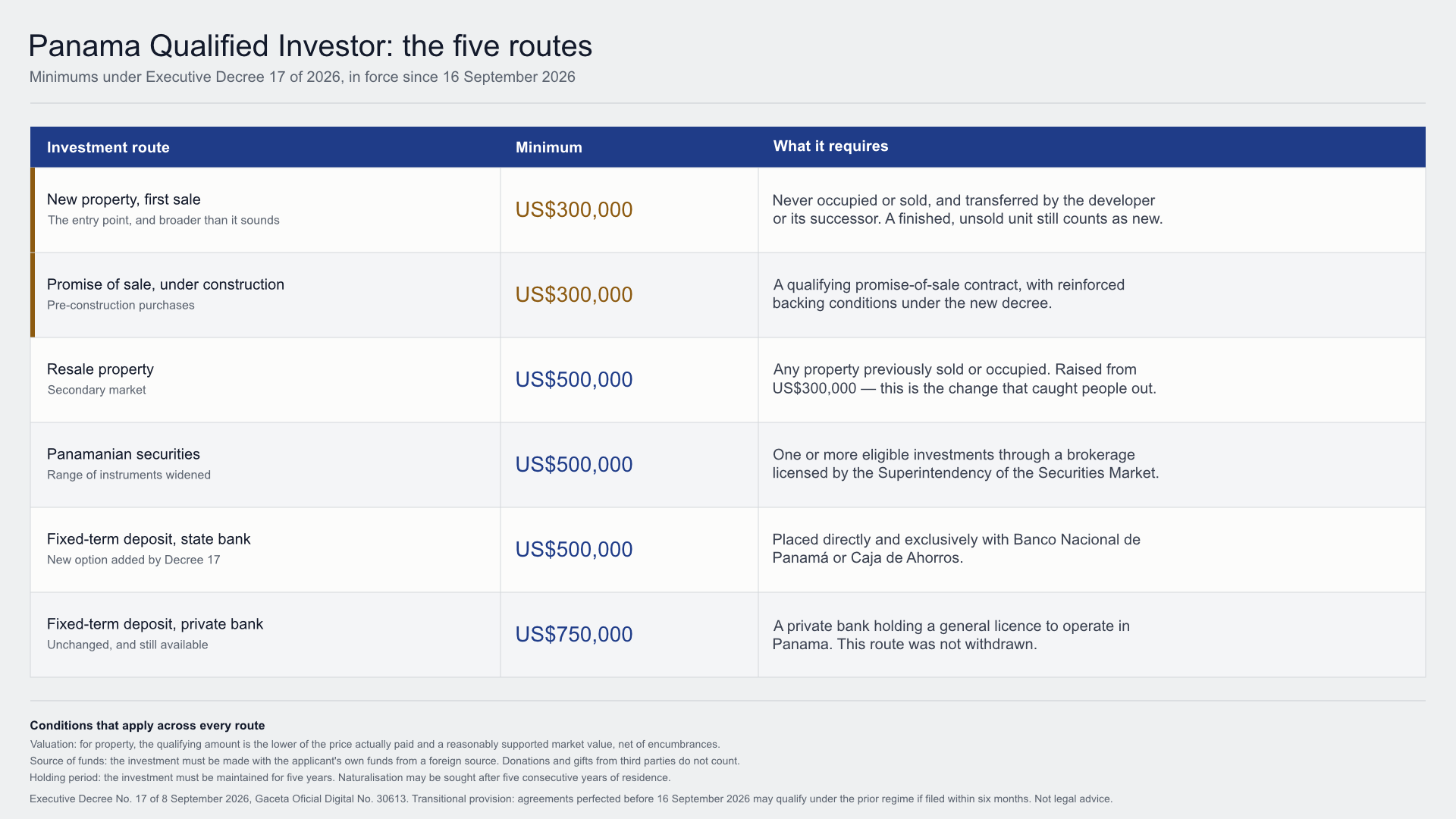
The Ministry of Commerce and Industries explained the policy clearly when it announced the change. It kept the $300,000 figure for first-sale properties to encourage new development and boost construction, services, and trade.
One important detail: the rule is broader than it seems. A finished unit that has never been occupied or sold still counts as new. This is not limited to off-plan purchases.
The change nobody is reporting: one route got cheaper
Most articles focus on the price increase, but Decree 17 also includes a price cut.
The fixed-term deposit route has been split in two. A deposit with a private bank holding a general licence still requires US$750,000, unchanged. But Decree 17 adds a new option: US$500,000 placed directly and exclusively with Banco Nacional de Panamá or Caja de Ahorros, the two state banks.
For investors seeking Panamanian residency without owning property, the cheapest entry point just dropped by $250,000. This change is more significant than the resale adjustment, but it has barely been mentioned.
The deadline that is real: 16 March 2027
Decree 17 includes a transitional provision, and that is where the real urgency is.
Investments and binding agreements completed before 16 September 2026 may still qualify under the previous regime, as long as you file the application within six months of that date. This sets a deadline of around 16 March 2027.
If you signed a purchase on a resale property between $300,000 and $500,000 before mid-September, you are not stranded. However, you are on a deadline, and it is not the one being advertised.
If you have not yet committed, the transitional provision does not help you. You are under the new rules, so the main question is whether the property is a first sale or a resale.
The other substantive changes
Three provisions are more important than the headline figures for anyone preparing an application.
Valuation is now defined
For immigration purposes, the relevant amount is the lower of the price actually paid or a reasonably supported market value, after subtracting any encumbrances. Paying above market value to meet the threshold will not work.
Panamanian counsel put it simply: paying US$550,000 for a secondary-market property with a recognised commercial value of US$480,000 does not meet the US$500,000 minimum. Even if the title has no encumbrances, the shortfall is measured against the valuation, not the invoice.
Funds must be your own and foreign-sourced
The decree clearly states that donations, gifts, and other free transfers from third parties do not count toward the minimum. It also strengthens the requirement to prove ownership and traceability. Family-funded applications may need restructuring, not just new documents.
One important point: funds already on deposit in Panama can still count, as long as their origin traces back to a prior international transfer.
The key is where the money came from, not where it is now. This matters for anyone who moved capital into Panama before applying. The money is not disqualified, but the paper trail back to its foreign source must be clear.
Processing times are now specified
The decree sets a maximum of 15 business days to issue the investment certification after receiving a complete file, and up to 30 business days to resolve the residency application after formally receiving a complete file. These are statutory targets, not guarantees, and the words "complete file" are important here. Still, it is a meaningful commitment, and few programs make one.
The decree also clearly states that Qualified Investors and their dependants may apply for Panamanian nationality by naturalisation after five consecutive years of residence, with those applications handled through the MICI window. This makes it a long-term citizenship route, not just a residence permit.
The investment must be held for five years
Decree 17 requires you to maintain the qualifying investment for five years. This is not just a formality. Residency is granted based on the investment, and the obligation continues for the full period.
This changes how the options compare. A $300,000 first-sale property and a $500,000 state-bank deposit both require a five-year commitment. The question is not just which costs less, but where you would prefer to keep your capital for five years.
A property may appreciate, generate rent, and be genuinely useful to you; it also requires maintenance and management and carries the risk of a soft resale market when the five years are up.
A fixed-term deposit does none of those things, but it is simple, requires no management from abroad, and you know exactly what you'll get back.
The holding period also runs alongside the naturalisation timeline. Qualified Investors may apply for Panamanian nationality after five consecutive years of residence. So, if your goal is a Panamanian passport, the investment needs to stay in place for almost the entire qualifying period.
What this means in practice
The planning question has changed. It is no longer "do I have $300,000 or $500,000". Now, it is "what is the title history of the property I am looking at".
A buyer with $300,000 is still in the programme, but the search is now limited to new developments and completed units a developer has never sold.
A buyer looking at resale stock between $300,000 and $500,000 is now outside the programme on that route. However, the state-bank deposit at $500,000 may suit them better anyway, since it does not involve owning or managing property at all.
There is a second-order effect worth watching. Resale owners in the $300,000 to $500,000 range, especially in buildings popular with residency buyers, have lost part of their buyer pool.
It's unclear whether that shows up in prices. Residency buyers are a small share of transactions. However, if you are buying resale in that range for reasons other than residency, your negotiating position may have improved slightly.
Who Panama suits
Panama remains one of the least demanding residency programmes. The physical presence requirement is minimal. The programme grants permanent residence from the start, rather than a provisional stage. It can include dependants, including a spouse, children, and dependent parents. The country also operates a territorial tax system, so it does not tax foreign-sourced income locally.
It also sits outside the European regulatory pressure that is now reshaping Caribbean citizenship programmes. Panama grants residence, not citizenship, and it is not part of the EU visa-waiver framework that is currently under review. This means the questions being asked about Caribbean passports don't apply here.
On the other hand, this is residency, not a passport, and the naturalisation route takes five years with a genuine process at the end. Anyone who wants a second passport quickly is looking at the wrong programme.
Where to go from here
Panama has become a more precise programme, not a more expensive one. The threshold that applies to you depends on a documentary question: the property's sales history. This is easy to get wrong and can be costly if you discover it late.
If you are in the middle of a transaction, the first question to answer is whether your agreement was completed before 16 September. This determines which rules apply and whether the March deadline applies to you.
Frequently asked questions
Did Panama raise the Qualified Investor threshold to $500,000 in October 2026?
No. The rules changed on 16 September 2026 under Decree 17. New, first-sale property still qualifies at $300,000, while resale property now requires $500,000.
Can I still use the $300,000 option?
Yes, if you buy new first-sale property that has never been occupied or sold, or if you have a qualifying promise-of-sale on a project under construction.
What if I agreed to a purchase before the rules changed?
If you completed your investment or binding agreement before 16 September 2026, you can still qualify under the old rules if you file your application within six months of that date, around 16 March 2027.
What is the most affordable way to join the program now?
For property, you need $300,000 for first-sale stock. If you are not investing in property, you can use the fixed-term deposit option through Banco Nacional de Panamá or Caja de Ahorros for $500,000. The private-bank deposit route remains available at $750,000.
Ready to get started?
Speak to our friendly team of experts today to learn more or to begin your journey.
Recommended for You

The Trump Gold Card, Nine Months In
7 October 2026
Portugal's New Citizenship Rules: Where Things Stand
30 September 2026
EU vs Caribbean Citizenship-by-Investment: What Changed in 2026
23 September 2026
EB-5 Grandfathering: The 30 September Deadline, Explained
16 September 2026

Latvia's Door Is Closing: The Question Is Whether You'll Walk Through It First
14 August 2026

Portugal Golden Visa: Important Update May 2026
27 May 2026

What’s Better: Trump’s Gold Card vs the EB-5 Visa?
16 January 2026

Portugal’s Golden Visa: What Three Years of Change Tell Global Citizens About 2026
17 December 2025

How Do H-1B Visa Changes Affect the EB-3 & EB-5 Visas?
26 September 2025
The Panama Qualified Investor Visa: What Changed and What Didn’t
Published on: 22nd October 2026
Throughout this year, people researching Panamanian residency have heard the same message: the Qualified Investor property threshold will rise from $300,000 to $500,000 on 15 October 2026, so act now or pay $200,000 more later.
No official decree ever mentioned that deadline. The rules actually changed on 16 September 2026, which was a month earlier than expected.
The $300,000 entry point remains. The main change is which properties now qualify at that price point.
What Decree 17 actually did
Executive Decree No. 17, dated 8 September 2026, was published in Gaceta Oficial Digital No. 30613 on 16 September and took effect that same day. It replaces Executive Decree 722 of 2020 and all later amendments, bringing the entire Qualified Investor program under one set of rules.
Now, the real estate threshold depends on the property's sales history:
The Ministry of Commerce and Industries explained the policy clearly when it announced the change. It kept the $300,000 figure for first-sale properties to encourage new development and boost construction, services, and trade.
One important detail: the rule is broader than it seems. A finished unit that has never been occupied or sold still counts as new. This is not limited to off-plan purchases.
The change nobody is reporting: one route got cheaper
Most articles focus on the price increase, but Decree 17 also includes a price cut.
The fixed-term deposit route has been split in two. A deposit with a private bank holding a general licence still requires US$750,000, unchanged. But Decree 17 adds a new option: US$500,000 placed directly and exclusively with Banco Nacional de Panamá or Caja de Ahorros, the two state banks.
For investors seeking Panamanian residency without owning property, the cheapest entry point just dropped by $250,000. This change is more significant than the resale adjustment, but it has barely been mentioned.
The deadline that is real: 16 March 2027
Decree 17 includes a transitional provision, and that is where the real urgency is.
Investments and binding agreements completed before 16 September 2026 may still qualify under the previous regime, as long as you file the application within six months of that date. This sets a deadline of around 16 March 2027.
If you signed a purchase on a resale property between $300,000 and $500,000 before mid-September, you are not stranded. However, you are on a deadline, and it is not the one being advertised.
If you have not yet committed, the transitional provision does not help you. You are under the new rules, so the main question is whether the property is a first sale or a resale.
The other substantive changes
Three provisions are more important than the headline figures for anyone preparing an application.
Valuation is now defined
For immigration purposes, the relevant amount is the lower of the price actually paid or a reasonably supported market value, after subtracting any encumbrances. Paying above market value to meet the threshold will not work.
Panamanian counsel put it simply: paying US$550,000 for a secondary-market property with a recognised commercial value of US$480,000 does not meet the US$500,000 minimum. Even if the title has no encumbrances, the shortfall is measured against the valuation, not the invoice.
Funds must be your own and foreign-sourced
The decree clearly states that donations, gifts, and other free transfers from third parties do not count toward the minimum. It also strengthens the requirement to prove ownership and traceability. Family-funded applications may need restructuring, not just new documents.
One important point: funds already on deposit in Panama can still count, as long as their origin traces back to a prior international transfer.
The key is where the money came from, not where it is now. This matters for anyone who moved capital into Panama before applying. The money is not disqualified, but the paper trail back to its foreign source must be clear.
Processing times are now specified
The decree sets a maximum of 15 business days to issue the investment certification after receiving a complete file, and up to 30 business days to resolve the residency application after formally receiving a complete file. These are statutory targets, not guarantees, and the words "complete file" are important here. Still, it is a meaningful commitment, and few programs make one.
The decree also clearly states that Qualified Investors and their dependants may apply for Panamanian nationality by naturalisation after five consecutive years of residence, with those applications handled through the MICI window. This makes it a long-term citizenship route, not just a residence permit.
The investment must be held for five years
Decree 17 requires you to maintain the qualifying investment for five years. This is not just a formality. Residency is granted based on the investment, and the obligation continues for the full period.
This changes how the options compare. A $300,000 first-sale property and a $500,000 state-bank deposit both require a five-year commitment. The question is not just which costs less, but where you would prefer to keep your capital for five years.
A property may appreciate, generate rent, and be genuinely useful to you; it also requires maintenance and management and carries the risk of a soft resale market when the five years are up.
A fixed-term deposit does none of those things, but it is simple, requires no management from abroad, and you know exactly what you'll get back.
The holding period also runs alongside the naturalisation timeline. Qualified Investors may apply for Panamanian nationality after five consecutive years of residence. So, if your goal is a Panamanian passport, the investment needs to stay in place for almost the entire qualifying period.
What this means in practice
The planning question has changed. It is no longer "do I have $300,000 or $500,000". Now, it is "what is the title history of the property I am looking at".
A buyer with $300,000 is still in the programme, but the search is now limited to new developments and completed units a developer has never sold.
A buyer looking at resale stock between $300,000 and $500,000 is now outside the programme on that route. However, the state-bank deposit at $500,000 may suit them better anyway, since it does not involve owning or managing property at all.
There is a second-order effect worth watching. Resale owners in the $300,000 to $500,000 range, especially in buildings popular with residency buyers, have lost part of their buyer pool.
It's unclear whether that shows up in prices. Residency buyers are a small share of transactions. However, if you are buying resale in that range for reasons other than residency, your negotiating position may have improved slightly.
Who Panama suits
Panama remains one of the least demanding residency programmes. The physical presence requirement is minimal. The programme grants permanent residence from the start, rather than a provisional stage. It can include dependants, including a spouse, children, and dependent parents. The country also operates a territorial tax system, so it does not tax foreign-sourced income locally.
It also sits outside the European regulatory pressure that is now reshaping Caribbean citizenship programmes. Panama grants residence, not citizenship, and it is not part of the EU visa-waiver framework that is currently under review. This means the questions being asked about Caribbean passports don't apply here.
On the other hand, this is residency, not a passport, and the naturalisation route takes five years with a genuine process at the end. Anyone who wants a second passport quickly is looking at the wrong programme.
Where to go from here
Panama has become a more precise programme, not a more expensive one. The threshold that applies to you depends on a documentary question: the property's sales history. This is easy to get wrong and can be costly if you discover it late.
If you are in the middle of a transaction, the first question to answer is whether your agreement was completed before 16 September. This determines which rules apply and whether the March deadline applies to you.
Frequently asked questions
Did Panama raise the Qualified Investor threshold to $500,000 in October 2026?
No. The rules changed on 16 September 2026 under Decree 17. New, first-sale property still qualifies at $300,000, while resale property now requires $500,000.
Can I still use the $300,000 option?
Yes, if you buy new first-sale property that has never been occupied or sold, or if you have a qualifying promise-of-sale on a project under construction.
What if I agreed to a purchase before the rules changed?
If you completed your investment or binding agreement before 16 September 2026, you can still qualify under the old rules if you file your application within six months of that date, around 16 March 2027.
What is the most affordable way to join the program now?
For property, you need $300,000 for first-sale stock. If you are not investing in property, you can use the fixed-term deposit option through Banco Nacional de Panamá or Caja de Ahorros for $500,000. The private-bank deposit route remains available at $750,000.
Need professional financial advice?
We have 18 offices across the globe and we manage over $2billion for our 20,000+ clients