Spain's Golden Visa Closed, The Citizenship Fast-Track Didn't
13th November 2026

Spain's Golden Visa ended on 3 April 2025. It will not return, and there is no new investor route to replace it.
If you are looking for a fast-track way to get a Spanish passport, that option is still available. It was never linked to the Golden Visa, so losing the visa did not affect this route.
What happened to the Spanish Golden Visa?
Spain repealed the investor route through Ley Orgánica 1/2025, with effect from 3 April 2025.
This was not a temporary pause. The articles that created the programme are now marked sin contenido, meaning "without content" in Spanish law. They were not amended or suspended but simply removed.
No investment route survived: not the €500,000 property purchase, shares, bank deposits, or government bonds. Applications filed before 3 April 2025 continue under the old rules, and existing holders keep and can renew their permits.
The part that survived
Spanish nationality law has long provided a shortened route to citizenship for certain nationalities. It requires two years of legal residence rather than ten, and it applies to citizens of:
Ibero-American countries, such as Brazil, Argentina, Chile and Colombia, etc.
The Philippines
Equatorial Guinea
Andorra
Portugal
People of Sephardic origin
One qualification that catches people out is Article 22.1, which requires you to be a national of origin of one of those countries, not someone who acquired nationality later. Someone born in Haiti who later obtained Dominican nationality by residence does not get the two-year period but ten.
This is part of the Civil Code. It depends on who you are, not how you got your residence permit. The Golden Visa was a convenient way to get that permit, likely the most convenient ever, but never the reason for the entitlement.
One year rather than two
Some people can qualify for Spanish citizenship after just one year of legal residence. The categories that matter most here:
Anyone born outside Spain to a Spanish parent or grandparent. The ancestor does not need to have been born in Spain. They only need to have been Spanish from birth, not naturalised.
Spouses of Spanish nationals, after one year of marriage and not legally separated
Widows and widowers of Spanish nationals
Anyone born in Spanish territory
This is more important than it might seem, for two reasons.
One year beats two
If you have an Ibero-American nationality and a Spanish parent or grandparent, you qualify under both rules. Most guides mention only the two-year route, so people often plan for twice as much residence as needed.
The alternative closed last year
The Democratic Memory Law, also called the "grandchildren's law," allowed descendants of Spaniards to claim nationality without living in Spain. This option closed on 22 October 2025, after a one-year extension, and consular appointment systems closed the next day. Applications filed in time are still being processed, but there is no new window.
If you missed that deadline, you can still claim descent but now need one year of legal residence in Spain. Until April 2025, the Golden Visa was the easiest way to get that year of residence.
So, for anyone in these groups, the question is not whether a shortened route exists. The real question is which permit you use to start the process.
What has actually changed for you
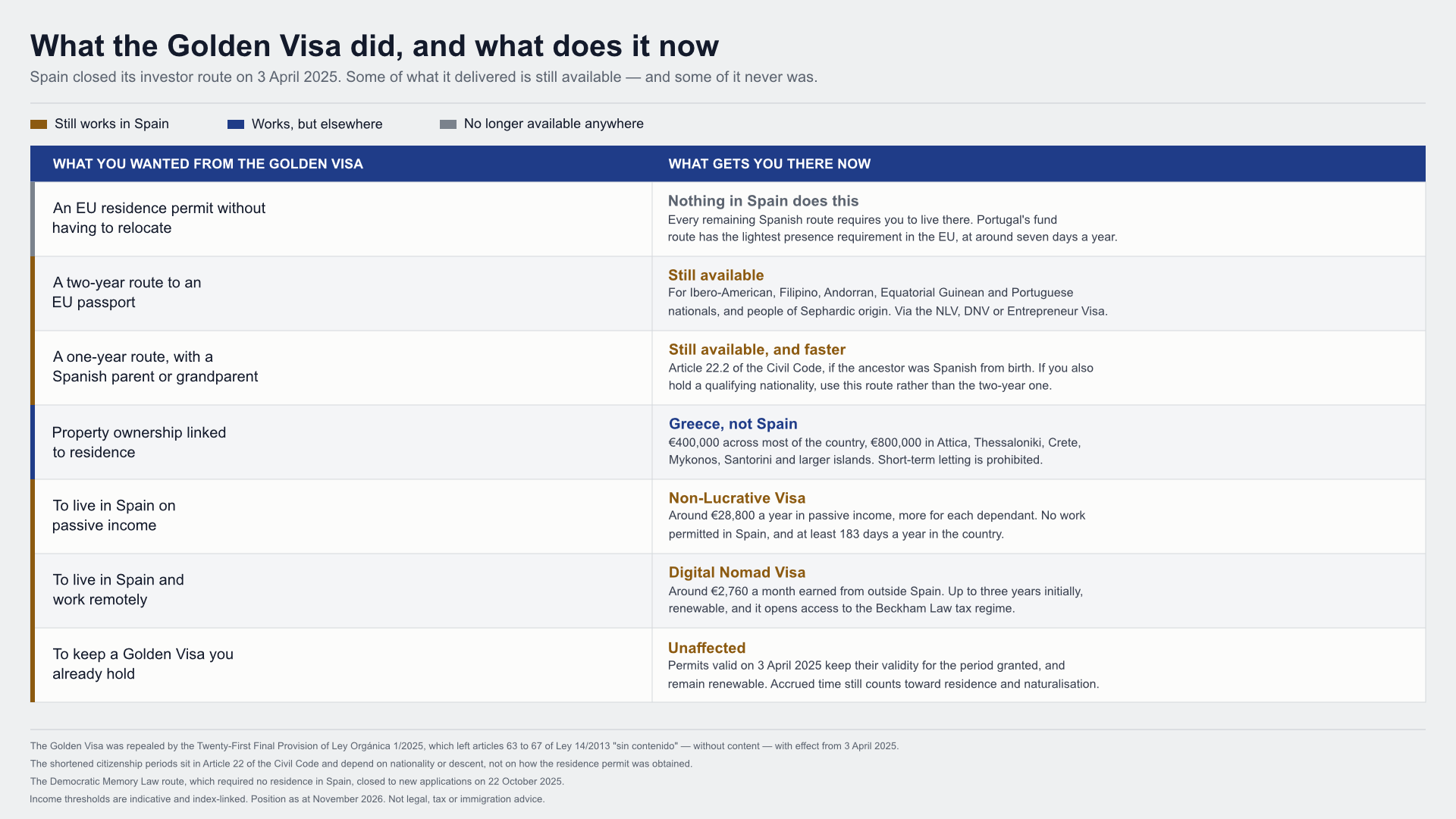
The Golden Visa required almost no presence. A single visit a year kept it alive, making it attractive to people who wanted an EU foothold without relocating.
But the two-year citizenship route always required real residence. You could hold a Golden Visa for ten years without moving to Spain, but you could not get citizenship in two years without living there. The residence requirement has not changed.
The permits now available require you to live in Spain, so the gap between permit demands and citizenship requirements is gone.
If you planned to move to Spain, you have lost a convenience. If you hoped to get a Spanish passport without living there, that was never possible through this route.
The routes that now get you there
Three permits realistically start the clock.
The Non-Lucrative Visa
The Non-Lucrative Visa (NLV) allows non-EU/EEA citizens to live in Spain for 90 days without working, provided they can support themselves financially. This can include retirees, those living on investment income or savings.
It requires passive income of about €28,800 a year, set at four times the IPREM index, with more for each dependent. You cannot work in Spain on this visa. You must spend at least 183 days a year in the country, also required for citizenship.
The Digital Nomad Visa
This visa is for remote employees and freelancers earning outside Spain, with a minimum income of about €2,760 a month. The initial authorisation lasts up to three years and can be renewed in two-year blocks. It also provides access to the Beckham Law special tax regime, which is advantageous for the first few years.
The Entrepreneur Visa
This is a three-year residence permit for people starting an innovative business in Spain. It requires a favourable report from ENISA. It is harder to get than the other two permits but suits someone truly building a business.
If you are not in the fast-track group
If you do not have one of those nationalities, Spanish citizenship takes ten years of legal residence with real presence, plus the DELE A2 language exam and the CCSE constitutional and cultural knowledge test. That is a long process, and Spain no longer offers an easy permit at the start.
For most investors in that situation, Spain is no longer a residence-by-investment option. Here is where people have gone instead:
Greece: Now the strongest property-linked route in the EU, at €400,000 for most of the country and €800,000 in Attica, Thessaloniki, Crete, and the larger islands. Keep in mind that short-term letting of the property is not allowed.
Portugal: Closed its residential property route in 2023 and extended its citizenship timeline to seven or ten years in May 2026. However, it still has a fund route and the lightest physical presence requirement in Europe.
Hungary: Offers a newer and less crowded Guest Investor Programme.
None of these countries offers what Spain offered Latin American applicants. A two-year path to an EU passport does not exist elsewhere, which is why this route is worth keeping if you qualify.
If you already hold a Spanish Golden Visa
Nothing has changed for you. Permits given before 3 April 2025 are still valid and can be renewed on the original terms. Time you have already spent still counts toward permanent residence and naturalisation as before.
If you are up for renewal, make sure your qualifying investment still meets the conditions of your original permit. Where to go from here
If you have one of the fast-track nationalities, Spain is still the shortest route to an EU passport. It takes two years instead of seven or ten elsewhere. The Golden Visa made the first step easy, but now you need to choose the right permit and move to Spain.
If you do not, it is more helpful to talk about which European programme best fits your goals, rather than looking for one most like the Spanish Golden Visa.
This article is for information only. It is not legal, tax, immigration or investment advice, and it is not an offer or a financial promotion. Programme rules change frequently — verify the current position before acting.
Ready to get started?
Speak to our friendly team of experts today to learn more or to begin your journey.
Recommended for You

St Kitts Is Winding Down Its CBI Programme, But It Hasn’t Closed
16 November 2026

Latvia Golden Visa 2026: What Closed and What's Left
11 November 2026

Greece Golden Visa 2026: The Tiers, the Rental Ban and the 44% Drop
29 October 2026

The Panama Qualified Investor Visa: What Changed and What Didn’t
22 October 2026

The Trump Gold Card, Nine Months In
7 October 2026

Portugal's New Citizenship Rules: Where Things Stand
30 September 2026

EU vs Caribbean Citizenship-by-Investment: What Changed in 2026
23 September 2026

EB-5 Grandfathering: The 30 September Deadline, Explained
16 September 2026

Portugal Golden Visa: Important Update May 2026
27 May 2026
Spain's Golden Visa Closed, The Citizenship Fast-Track Didn't
Published on: 13th November 2026
Spain's Golden Visa ended on 3 April 2025. It will not return, and there is no new investor route to replace it.
If you are looking for a fast-track way to get a Spanish passport, that option is still available. It was never linked to the Golden Visa, so losing the visa did not affect this route.
What happened to the Spanish Golden Visa?
Spain repealed the investor route through Ley Orgánica 1/2025, with effect from 3 April 2025.
This was not a temporary pause. The articles that created the programme are now marked sin contenido, meaning "without content" in Spanish law. They were not amended or suspended but simply removed.
No investment route survived: not the €500,000 property purchase, shares, bank deposits, or government bonds. Applications filed before 3 April 2025 continue under the old rules, and existing holders keep and can renew their permits.
The part that survived
Spanish nationality law has long provided a shortened route to citizenship for certain nationalities. It requires two years of legal residence rather than ten, and it applies to citizens of:
Ibero-American countries, such as Brazil, Argentina, Chile and Colombia, etc.
The Philippines
Equatorial Guinea
Andorra
Portugal
People of Sephardic origin
One qualification that catches people out is Article 22.1, which requires you to be a national of origin of one of those countries, not someone who acquired nationality later. Someone born in Haiti who later obtained Dominican nationality by residence does not get the two-year period but ten.
This is part of the Civil Code. It depends on who you are, not how you got your residence permit. The Golden Visa was a convenient way to get that permit, likely the most convenient ever, but never the reason for the entitlement.
One year rather than two
Some people can qualify for Spanish citizenship after just one year of legal residence. The categories that matter most here:
Anyone born outside Spain to a Spanish parent or grandparent. The ancestor does not need to have been born in Spain. They only need to have been Spanish from birth, not naturalised.
Spouses of Spanish nationals, after one year of marriage and not legally separated
Widows and widowers of Spanish nationals
Anyone born in Spanish territory
This is more important than it might seem, for two reasons.
One year beats two
If you have an Ibero-American nationality and a Spanish parent or grandparent, you qualify under both rules. Most guides mention only the two-year route, so people often plan for twice as much residence as needed.
The alternative closed last year
The Democratic Memory Law, also called the "grandchildren's law," allowed descendants of Spaniards to claim nationality without living in Spain. This option closed on 22 October 2025, after a one-year extension, and consular appointment systems closed the next day. Applications filed in time are still being processed, but there is no new window.
If you missed that deadline, you can still claim descent but now need one year of legal residence in Spain. Until April 2025, the Golden Visa was the easiest way to get that year of residence.
So, for anyone in these groups, the question is not whether a shortened route exists. The real question is which permit you use to start the process.
What has actually changed for you
The Golden Visa required almost no presence. A single visit a year kept it alive, making it attractive to people who wanted an EU foothold without relocating.
But the two-year citizenship route always required real residence. You could hold a Golden Visa for ten years without moving to Spain, but you could not get citizenship in two years without living there. The residence requirement has not changed.
The permits now available require you to live in Spain, so the gap between permit demands and citizenship requirements is gone.
If you planned to move to Spain, you have lost a convenience. If you hoped to get a Spanish passport without living there, that was never possible through this route.
The routes that now get you there
Three permits realistically start the clock.
The Non-Lucrative Visa
The Non-Lucrative Visa (NLV) allows non-EU/EEA citizens to live in Spain for 90 days without working, provided they can support themselves financially. This can include retirees, those living on investment income or savings.
It requires passive income of about €28,800 a year, set at four times the IPREM index, with more for each dependent. You cannot work in Spain on this visa. You must spend at least 183 days a year in the country, also required for citizenship.
The Digital Nomad Visa
This visa is for remote employees and freelancers earning outside Spain, with a minimum income of about €2,760 a month. The initial authorisation lasts up to three years and can be renewed in two-year blocks. It also provides access to the Beckham Law special tax regime, which is advantageous for the first few years.
The Entrepreneur Visa
This is a three-year residence permit for people starting an innovative business in Spain. It requires a favourable report from ENISA. It is harder to get than the other two permits but suits someone truly building a business.
If you are not in the fast-track group
If you do not have one of those nationalities, Spanish citizenship takes ten years of legal residence with real presence, plus the DELE A2 language exam and the CCSE constitutional and cultural knowledge test. That is a long process, and Spain no longer offers an easy permit at the start.
For most investors in that situation, Spain is no longer a residence-by-investment option. Here is where people have gone instead:
Greece: Now the strongest property-linked route in the EU, at €400,000 for most of the country and €800,000 in Attica, Thessaloniki, Crete, and the larger islands. Keep in mind that short-term letting of the property is not allowed.
Portugal: Closed its residential property route in 2023 and extended its citizenship timeline to seven or ten years in May 2026. However, it still has a fund route and the lightest physical presence requirement in Europe.
Hungary: Offers a newer and less crowded Guest Investor Programme.
None of these countries offers what Spain offered Latin American applicants. A two-year path to an EU passport does not exist elsewhere, which is why this route is worth keeping if you qualify.
If you already hold a Spanish Golden Visa
Nothing has changed for you. Permits given before 3 April 2025 are still valid and can be renewed on the original terms. Time you have already spent still counts toward permanent residence and naturalisation as before.
If you are up for renewal, make sure your qualifying investment still meets the conditions of your original permit. Where to go from here
If you have one of the fast-track nationalities, Spain is still the shortest route to an EU passport. It takes two years instead of seven or ten elsewhere. The Golden Visa made the first step easy, but now you need to choose the right permit and move to Spain.
If you do not, it is more helpful to talk about which European programme best fits your goals, rather than looking for one most like the Spanish Golden Visa.
This article is for information only. It is not legal, tax, immigration or investment advice, and it is not an offer or a financial promotion. Programme rules change frequently — verify the current position before acting.
Need professional financial advice?
We have 18 offices across the globe and we manage over $2billion for our 20,000+ clients