Greece Golden Visa 2026: The Tiers, the Rental Ban and the 44% Drop
29th October 2026

If you search for the Greek Golden Visa, you might still see €250,000 listed as the entry price. While it still exists, it hasn't been the standard threshold since 2024.
Greece has five investment options and now uses a three-tier system for real estate investments. For most buyers, the real amount is €400,000 or €800,000. The €250,000 option is now only available in rare situations. In addition, a recent rule change, which many have missed, has ended the rental-income model that has been part of the programme for the past decade.
We believe it is still the strongest property-linked residence option in the European Union. However, the programme is much more demanding than most published guides suggest.
Where the €250,000 option went
Law 5100/2024, Article 100, sets the tiers, not the 2026 reform, as many reports claim. These rules have been in force since 2024 and have not changed.
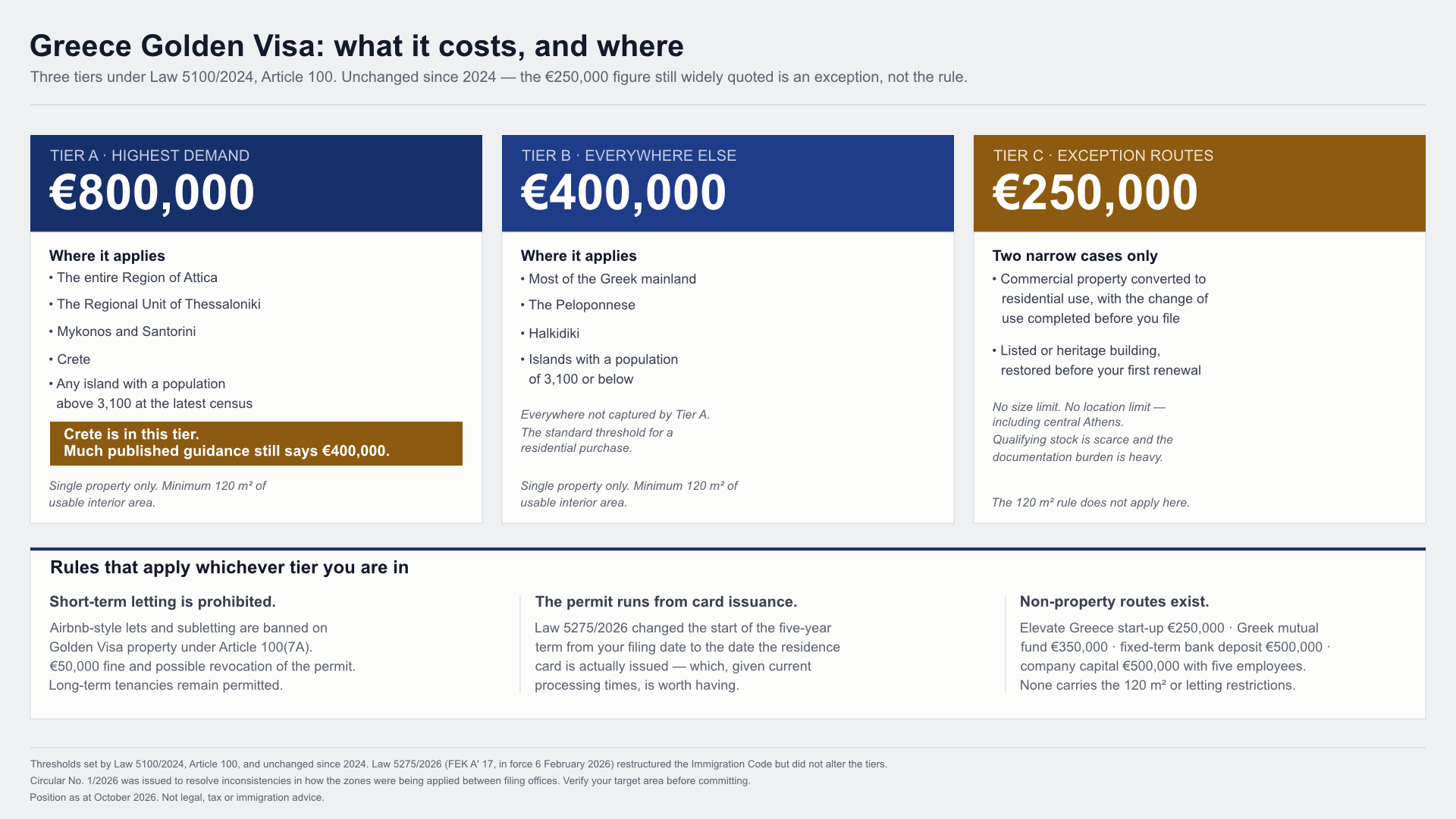
€800,000: Applies across the entire Region of Attica, the Regional Unit of Thessaloniki, Mykonos, Santorini, and any island with a population above 3,100 at the latest census.
€400,000: Applies everywhere else, including most of the mainland, the Peloponnese, Halkidiki, and smaller islands.
€250,000: Applies only in two specific cases. The first is a commercial property converted to residential use, where you complete the change of use before you file. The second is a listed or heritage building that you restore before your first renewal.
Two conditions apply to the €400,000 and €800,000 tiers, and these often catch people out. The investment must be a single property. For example, two apartments totalling €400,000 do not qualify. The property must also have at least 120 m² of usable interior area.
These restrictions do not apply to the €250,000 conversion and restoration routes, which have no size limit and can be anywhere in the country, including central Athens.
The error that could cost you €400,000
Crete is in the €800,000 tier. Many published guides, even from experienced firms, still list Crete at €400,000 for standard residential purchases. This is incorrect, as Crete does not qualify at that level.
If you are using a guide that puts Crete in the lower band, stop and check before you decide. Circular No. 1/2026 was issued to resolve inconsistencies in how different filing offices applied the zones, highlighting how much confusion there has been.
The change that rewrites the investment case
Even more important than the thresholds, short-term letting of a Golden Visa property is now banned.
Under Article 100(7A) of the Migration Code, as amended by Law 5100/2024, you cannot let or sublet property bought under the programme short-term through the sharing economy, such as Airbnb, Booking.com, and similar platforms. The penalty is a €50,000 fine and possible permit revocation.
The ban goes beyond platform listings. It also covers direct bookings and arrangements through intermediaries. A September 2024 Ministry Circular explains the scope and some exceptions for legacy and transitional properties. If you rely on one, confirm it in writing.
Long-term tenancies are still allowed, so base your yield calculations on annual rentals instead of tourist income, which means lower rents.
This ends the model that Greek buyers have used for their purchases over the past decade. If someone still presents this as an Airbnb investment, they are either out of date or not giving you the full picture.
What Law 5275/2026 actually did
The February 2026 reform, Law 5275/2026, published in FEK A' 17 and in force from 6 February, is often credited with the pricing changes. It did not affect them.
What it did:
Restructured the Immigration Code and introduced a unified procedure for residence and work permits
Changed when the permit starts running. The five-year period now begins on the date the residence card is issued, not the filing date. Because files have been taking longer, this change increases the permit's usable life.
Formalised a €250,000 start-up route through the Elevate Greece registry, as a non-property alternative
Reformed the national D-visa categories and the transition from D visa to residence permit
The change to when the permit starts is most important for applicants already in the queue, but it is rarely mentioned.
The routes that are not property
Greece has several non-property options that get almost no attention, and for some investors they are a better fit than a €400,000 apartment with restricted letting rights:
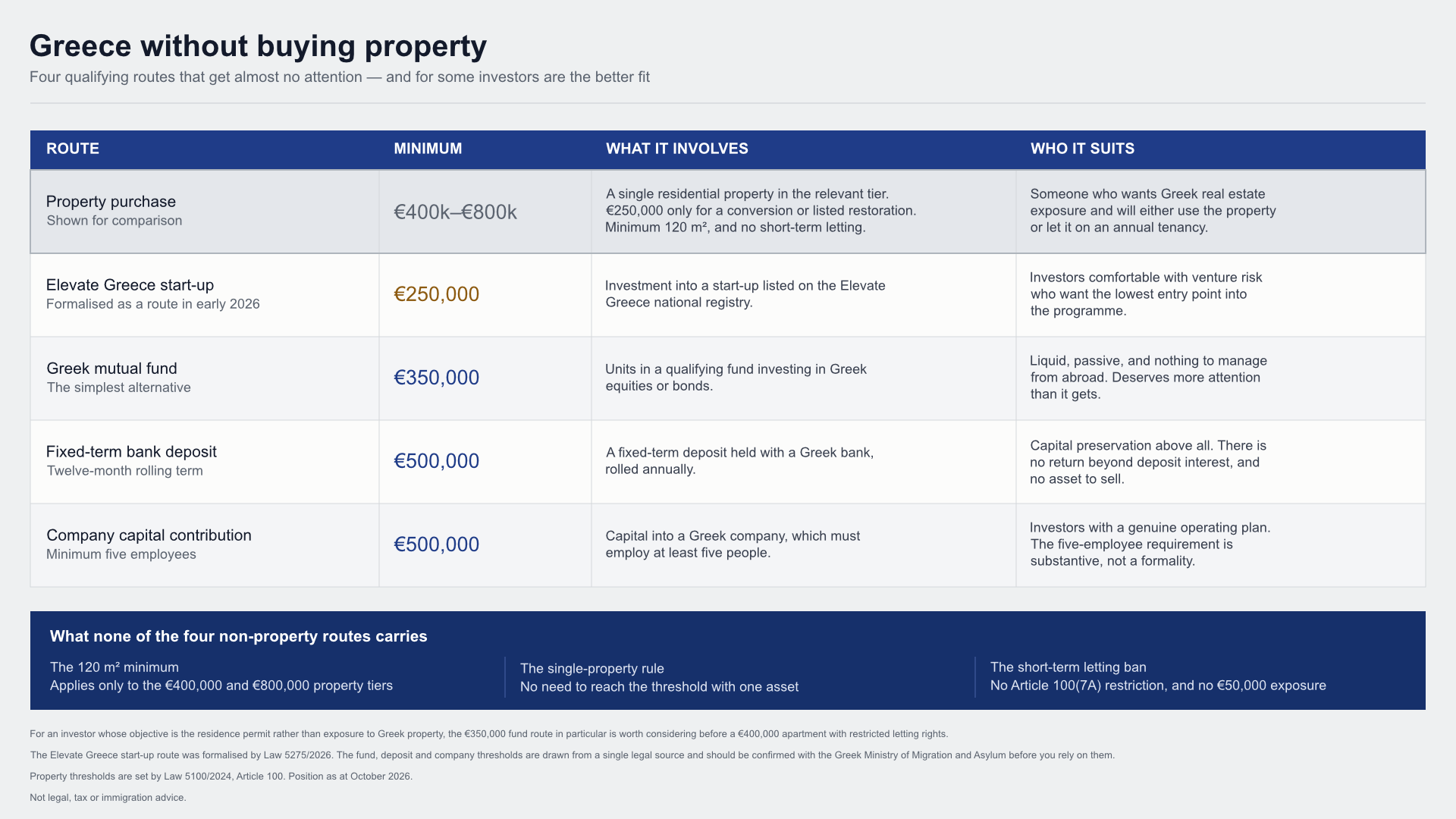
If your main goal is a residence permit rather than owning Greek real estate, the €350,000 fund route deserves more attention than it usually gets.
How long it actually takes
Greek law sets a two-month deadline for a decision on a Golden Visa application.
In reality, of the files submitted in February 2026, only 61% had a decision by August. Six months later, about four in ten applicants were still waiting.
However, things are getting better. The Ministry of Migration and Asylum reports that the backlog dropped from 35,669 pending files at the end of March 2026 to 33,051 at the end of May, a 7.3% reduction thanks to moving processing to regional offices. Average waits for well-prepared applications have gone down from 9–12 months in 2024 to about 4–6 months, with some regional offices clearing files in under 90 days.
Athens remains the bottleneck. Attica alone accounted for 5,730 pending cases.
There are two practical takeaways. Where you file matters as much as what you file. A regional office may be much faster than Athens. Also, when the Ministry says "well-prepared," it means incomplete files cause the long delays.
The 44% drop and what it tells you
Greece received about 9,386 initial applications in 2024, which was the peak. In the first half of 2026, it was 2,551, down from 4,553 a year earlier, a 44% drop. There were still 34,278 active investor permits at the end of July, so the total is large, but new demand has dropped sharply.
The reason is clear. Higher thresholds, the 120 m² rule, the single-property rule, and the rental ban have together removed the programme’s mass-market segment.
See this as a feature, not a failure. Greece deliberately moved the programme upmarket, and for buyers today, the slowdown means less competition for qualifying properties and a shorter queue than applicants faced in 2024.
This also matters strategically. A programme that has already corrected is less likely to face another. Spain ended its scheme in April 2025, Portugal doubled its citizenship timeline in May 2026, and Latvia will close its property and deposit routes on 1 January 2027.
Greece, which changed its prices in 2024 and has stayed steady since then, looks more stable by comparison.
Greece against the alternatives
Against Portugal
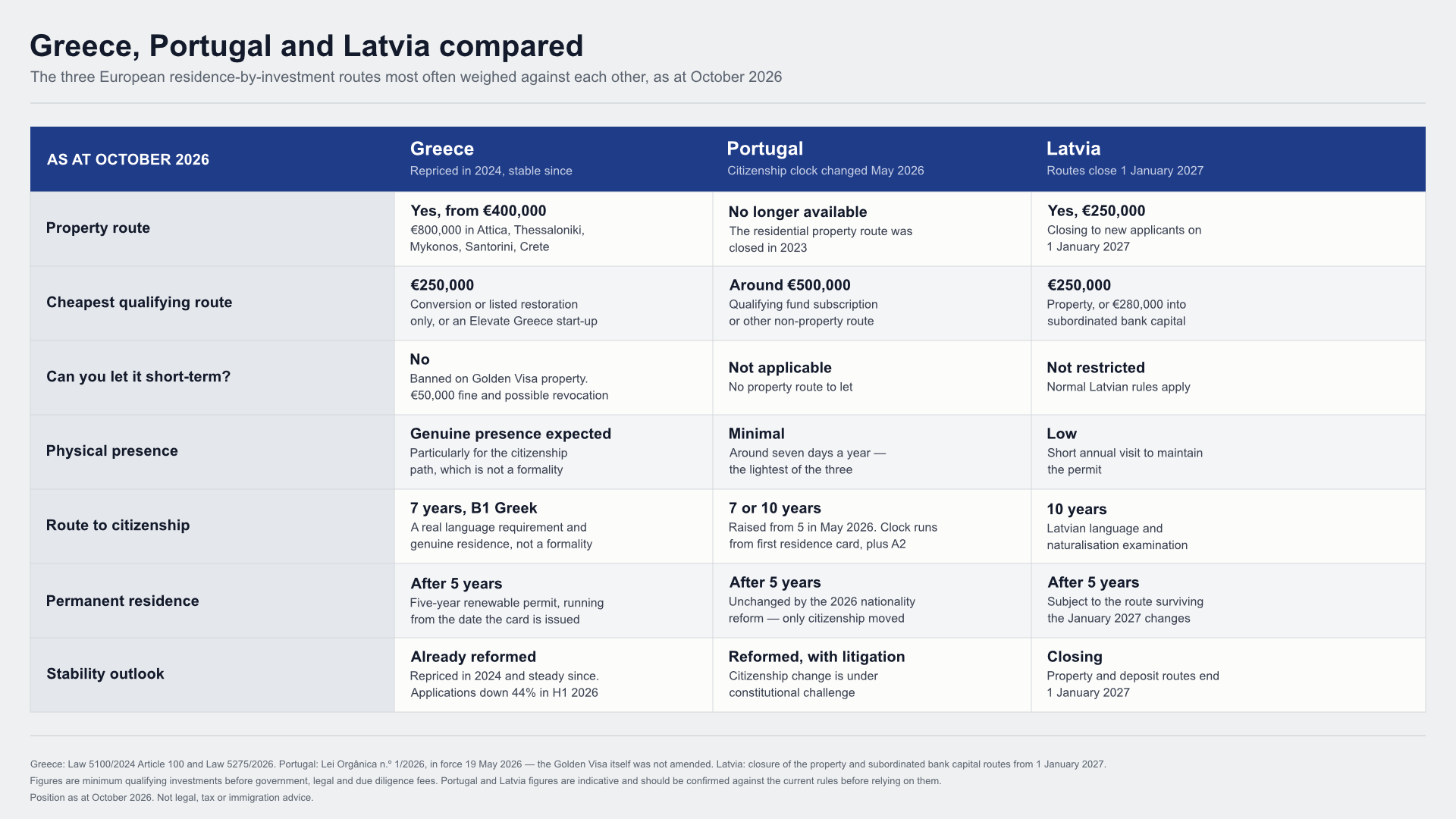
Portugal no longer offers a residential property route, and its citizenship timeline increased to 7 or 10 years in May 2026. Greece still lets you buy property at a lower entry point than Portugal's fund routes in the €400,000 tier, and its permanent residence rules have not changed.
Portugal's advantage is its minimal physical presence requirement, while Greece's is that you can still buy a house.
Against Latvia
Latvia is cheaper today but is closing soon. If you want a European residence permit at the lowest cost and can finish before the end of the year, Latvia is the short-term option. Greece will still be available in 2028.
On citizenship
Greece requires seven years of residence, B1-level Greek (a real language requirement, not just a formality), and real physical presence.
Greece offers a residence programme with a long, demanding path to citizenship, not a quick passport route. Anyone aiming for an EU passport within a set timeframe should compare options honestly rather than assume the permit gets you there quickly.
Who Greece suits in 2026
This programme suits someone who wants a real European base, plans to spend time in Greece, is comfortable with long-term letting or personal use instead of holiday income, and values the programme's recent reforms.
It is less suitable for buyers who depend on short-term rental yield, want to meet the threshold by buying several cheaper units, or are mainly looking for a quick route to an EU passport.
The €250,000 conversion route is genuinely attractive where you can find qualifying stock. There is no size limit, and it is available anywhere, including central Athens. However, supply is limited, and the documentation burden is significant. It is a project, not just a purchase.
Where to go from here
Greece is the strongest property-linked residence route left in the EU, but it is also more expensive, more restricted, and slower than most guides admit.
Before anything else, settle two questions: which tier your target area actually falls into (Crete being the obvious trap), and whether your return model works without short-term letting. Get those right, and the rest is just process.
Frequently asked questions
Can I still get a Greek Golden Visa for €250,000?
You can only qualify for the €250,000 amount if you convert a commercial property to residential use, restore a listed building, or use the Elevate Greece start-up route. Since 2024, standard residential purchases no longer qualify for this lower amount.
How much do I need for a property in Crete?
The required amount is €800,000. Crete is now in the higher tier, even though many sources still mention €400,000.
Can I rent my Greek Golden Visa property on Airbnb?
No, you cannot. Short-term rentals and subletting are not allowed. If you do, you risk a €50,000 fine and possibly losing your permit. Long-term rentals are permitted.
How long does the Greek Golden Visa take?
Officially, the process should take two months. In reality, by August, only 61% of applications from February 2026 had been decided. Well-prepared applications now take about four to six months, and regional offices are usually quicker than Athens.
Does the Greek Golden Visa lead to citizenship?
You can apply after seven years of living in Greece, but you need B1-level Greek and must actually live there. This is not a quick way to get a passport.
This article is for information only. It is not legal, tax, immigration or investment advice, and it is not an offer or a financial promotion. Programme rules change frequently — verify the current position before acting.
Ready to get started?
Speak to our friendly team of experts today to learn more or to begin your journey.
Recommended for You

St Kitts Is Winding Down Its CBI Programme, But It Hasn’t Closed
16 November 2026

Spain's Golden Visa Closed, The Citizenship Fast-Track Didn't
13 November 2026

Latvia Golden Visa 2026: What Closed and What's Left
11 November 2026

The Panama Qualified Investor Visa: What Changed and What Didn’t
22 October 2026

The Trump Gold Card, Nine Months In
7 October 2026

Portugal's New Citizenship Rules: Where Things Stand
30 September 2026

EU vs Caribbean Citizenship-by-Investment: What Changed in 2026
23 September 2026

EB-5 Grandfathering: The 30 September Deadline, Explained
16 September 2026

Portugal Golden Visa: Important Update May 2026
27 May 2026
Greece Golden Visa 2026: The Tiers, the Rental Ban and the 44% Drop
Published on: 29th October 2026
If you search for the Greek Golden Visa, you might still see €250,000 listed as the entry price. While it still exists, it hasn't been the standard threshold since 2024.
Greece has five investment options and now uses a three-tier system for real estate investments. For most buyers, the real amount is €400,000 or €800,000. The €250,000 option is now only available in rare situations. In addition, a recent rule change, which many have missed, has ended the rental-income model that has been part of the programme for the past decade.
We believe it is still the strongest property-linked residence option in the European Union. However, the programme is much more demanding than most published guides suggest.
Where the €250,000 option went
Law 5100/2024, Article 100, sets the tiers, not the 2026 reform, as many reports claim. These rules have been in force since 2024 and have not changed.
€800,000: Applies across the entire Region of Attica, the Regional Unit of Thessaloniki, Mykonos, Santorini, and any island with a population above 3,100 at the latest census.
€400,000: Applies everywhere else, including most of the mainland, the Peloponnese, Halkidiki, and smaller islands.
€250,000: Applies only in two specific cases. The first is a commercial property converted to residential use, where you complete the change of use before you file. The second is a listed or heritage building that you restore before your first renewal.
Two conditions apply to the €400,000 and €800,000 tiers, and these often catch people out. The investment must be a single property. For example, two apartments totalling €400,000 do not qualify. The property must also have at least 120 m² of usable interior area.
These restrictions do not apply to the €250,000 conversion and restoration routes, which have no size limit and can be anywhere in the country, including central Athens.
The error that could cost you €400,000
Crete is in the €800,000 tier. Many published guides, even from experienced firms, still list Crete at €400,000 for standard residential purchases. This is incorrect, as Crete does not qualify at that level.
If you are using a guide that puts Crete in the lower band, stop and check before you decide. Circular No. 1/2026 was issued to resolve inconsistencies in how different filing offices applied the zones, highlighting how much confusion there has been.
The change that rewrites the investment case
Even more important than the thresholds, short-term letting of a Golden Visa property is now banned.
Under Article 100(7A) of the Migration Code, as amended by Law 5100/2024, you cannot let or sublet property bought under the programme short-term through the sharing economy, such as Airbnb, Booking.com, and similar platforms. The penalty is a €50,000 fine and possible permit revocation.
The ban goes beyond platform listings. It also covers direct bookings and arrangements through intermediaries. A September 2024 Ministry Circular explains the scope and some exceptions for legacy and transitional properties. If you rely on one, confirm it in writing.
Long-term tenancies are still allowed, so base your yield calculations on annual rentals instead of tourist income, which means lower rents.
This ends the model that Greek buyers have used for their purchases over the past decade. If someone still presents this as an Airbnb investment, they are either out of date or not giving you the full picture.
What Law 5275/2026 actually did
The February 2026 reform, Law 5275/2026, published in FEK A' 17 and in force from 6 February, is often credited with the pricing changes. It did not affect them.
What it did:
Restructured the Immigration Code and introduced a unified procedure for residence and work permits
Changed when the permit starts running. The five-year period now begins on the date the residence card is issued, not the filing date. Because files have been taking longer, this change increases the permit's usable life.
Formalised a €250,000 start-up route through the Elevate Greece registry, as a non-property alternative
Reformed the national D-visa categories and the transition from D visa to residence permit
The change to when the permit starts is most important for applicants already in the queue, but it is rarely mentioned.
The routes that are not property
Greece has several non-property options that get almost no attention, and for some investors they are a better fit than a €400,000 apartment with restricted letting rights:
If your main goal is a residence permit rather than owning Greek real estate, the €350,000 fund route deserves more attention than it usually gets.
How long it actually takes
Greek law sets a two-month deadline for a decision on a Golden Visa application.
In reality, of the files submitted in February 2026, only 61% had a decision by August. Six months later, about four in ten applicants were still waiting.
However, things are getting better. The Ministry of Migration and Asylum reports that the backlog dropped from 35,669 pending files at the end of March 2026 to 33,051 at the end of May, a 7.3% reduction thanks to moving processing to regional offices. Average waits for well-prepared applications have gone down from 9–12 months in 2024 to about 4–6 months, with some regional offices clearing files in under 90 days.
Athens remains the bottleneck. Attica alone accounted for 5,730 pending cases.
There are two practical takeaways. Where you file matters as much as what you file. A regional office may be much faster than Athens. Also, when the Ministry says "well-prepared," it means incomplete files cause the long delays.
The 44% drop and what it tells you
Greece received about 9,386 initial applications in 2024, which was the peak. In the first half of 2026, it was 2,551, down from 4,553 a year earlier, a 44% drop. There were still 34,278 active investor permits at the end of July, so the total is large, but new demand has dropped sharply.
The reason is clear. Higher thresholds, the 120 m² rule, the single-property rule, and the rental ban have together removed the programme’s mass-market segment.
See this as a feature, not a failure. Greece deliberately moved the programme upmarket, and for buyers today, the slowdown means less competition for qualifying properties and a shorter queue than applicants faced in 2024.
This also matters strategically. A programme that has already corrected is less likely to face another. Spain ended its scheme in April 2025, Portugal doubled its citizenship timeline in May 2026, and Latvia will close its property and deposit routes on 1 January 2027.
Greece, which changed its prices in 2024 and has stayed steady since then, looks more stable by comparison.
Greece against the alternatives
Against Portugal
Portugal no longer offers a residential property route, and its citizenship timeline increased to 7 or 10 years in May 2026. Greece still lets you buy property at a lower entry point than Portugal's fund routes in the €400,000 tier, and its permanent residence rules have not changed.
Portugal's advantage is its minimal physical presence requirement, while Greece's is that you can still buy a house.
Against Latvia
Latvia is cheaper today but is closing soon. If you want a European residence permit at the lowest cost and can finish before the end of the year, Latvia is the short-term option. Greece will still be available in 2028.
On citizenship
Greece requires seven years of residence, B1-level Greek (a real language requirement, not just a formality), and real physical presence.
Greece offers a residence programme with a long, demanding path to citizenship, not a quick passport route. Anyone aiming for an EU passport within a set timeframe should compare options honestly rather than assume the permit gets you there quickly.
Who Greece suits in 2026
This programme suits someone who wants a real European base, plans to spend time in Greece, is comfortable with long-term letting or personal use instead of holiday income, and values the programme's recent reforms.
It is less suitable for buyers who depend on short-term rental yield, want to meet the threshold by buying several cheaper units, or are mainly looking for a quick route to an EU passport.
The €250,000 conversion route is genuinely attractive where you can find qualifying stock. There is no size limit, and it is available anywhere, including central Athens. However, supply is limited, and the documentation burden is significant. It is a project, not just a purchase.
Where to go from here
Greece is the strongest property-linked residence route left in the EU, but it is also more expensive, more restricted, and slower than most guides admit.
Before anything else, settle two questions: which tier your target area actually falls into (Crete being the obvious trap), and whether your return model works without short-term letting. Get those right, and the rest is just process.
Frequently asked questions
Can I still get a Greek Golden Visa for €250,000?
You can only qualify for the €250,000 amount if you convert a commercial property to residential use, restore a listed building, or use the Elevate Greece start-up route. Since 2024, standard residential purchases no longer qualify for this lower amount.
How much do I need for a property in Crete?
The required amount is €800,000. Crete is now in the higher tier, even though many sources still mention €400,000.
Can I rent my Greek Golden Visa property on Airbnb?
No, you cannot. Short-term rentals and subletting are not allowed. If you do, you risk a €50,000 fine and possibly losing your permit. Long-term rentals are permitted.
How long does the Greek Golden Visa take?
Officially, the process should take two months. In reality, by August, only 61% of applications from February 2026 had been decided. Well-prepared applications now take about four to six months, and regional offices are usually quicker than Athens.
Does the Greek Golden Visa lead to citizenship?
You can apply after seven years of living in Greece, but you need B1-level Greek and must actually live there. This is not a quick way to get a passport.
This article is for information only. It is not legal, tax, immigration or investment advice, and it is not an offer or a financial promotion. Programme rules change frequently — verify the current position before acting.
Need professional financial advice?
We have 18 offices across the globe and we manage over $2billion for our 20,000+ clients