The Trump Gold Card, Nine Months In
7th October 2026

At the launch of the Trump Gold Card, the Commerce Secretary predicted 80,000 cards would be issued and over $100 billion in revenue. Just days after applications opened, he announced that $1.3 billion worth of cards had already been sold.
Nine months later, the Department of Homeland Security reported to a federal court that 338 people had requested a Gold Card, 165 had paid the $15,000 processing fee, and 59 petitions had been filed. Only one person had been approved.
These numbers matter because they don't match up. If each card costs $1 million, $1.3 billion would mean about 1,300 buyers. When asked about this difference at a House Appropriations hearing in April, Lutnick did not respond.
This article does not debate whether the Gold Card is a good idea. Instead, it looks at why almost no one has bought one so far, and what these reasons can teach anyone considering a US immigration option.
Where the programme stands
Executive Order 14351 was signed on 19 September 2025. Applications opened on 10 December 2025 through the government's Gold Card website. Full agency guidance followed in March 2026.
The structure:
$1 million contribution from an individual, or $2 million from a corporation sponsoring an employee
$15,000 non-refundable processing fee to DHS
The contribution is paid after approval is confirmed, not upfront
Approved applicants receive an EB-1 or EB-2 immigrant visa and lawful permanent residence
Spouses and dependent children receive derivative green cards
The most recent figures, dated:
Requests submitted: 338 (DHS court filing, May 2026)
$15,000 fees paid: 165 (same filing)
Petitions filed: 59 (same filing)
Approvals: 1 (Lutnick testimony, 23 April 2026; still one as at late July)
Reason one: worldwide taxation
A Gold Card holder becomes a lawful permanent resident, and US permanent residents are taxed on all their worldwide income from the start. There are no exceptions. The programme offers no tax advantage.
For the target audience, this changes everything. A European residency permit costs much less, is usually refundable, and doesn't subject your global income to US taxes. Paying $1 million with no refund and accepting lifetime worldwide taxation is very different from what the marketing suggested.
The administration has suggested a Platinum Card at $5 million, which would reportedly let holders spend up to 270 days a year in the US without paying tax on non-US income. The executive order does not mention this card; it is not accepting applications, and there is only a waiting list. The promised tax treatment would almost certainly need a new law from Congress.
Reason two: you cannot buy a visa number
This is the part that gets the least attention but matters most.
The Gold Card did not create new visas. Approved petitions are handled within the existing EB-1 and EB-2 categories, which have annual per-country limits. Those limits still apply.
For people from countries with long backlogs, especially India and China, the Visa Bulletin wait is still years, no matter how much is paid. Current estimates put the wait between two and twelve years. The government has admitted there is no guaranteed advantage in processing speed.
So an Indian applicant can pay $15,000, get approved, commit $1 million, and still wait in the same line. "Record time," as the official site described it, was never something the programme could deliver for many of the people most likely to want it.
Another complication for these applicants remains. The E-2 treaty investor visa has no per-country cap, but it is only available to nationals of treaty countries. India and China are not on that list. This means the only U.S. visa option without a backlog is unavailable to the people most affected by the backlog.
For Indian or Chinese investors, the real choice is between a Gold Card that does not offer faster processing and EB-5’s reserved categories, which do.
Reason three: the legal position is unresolved
Two federal lawsuits are live in the District of Columbia.
The substantive one was filed on 3 February 2026 by the American Association of University Professors together with six immigrant professionals from Mexico, Colombia, Taiwan and Ghana. It argues the programme is unlawful under the Administrative Procedure Act and the Immigration and Nationality Act, and asks the court to declare it unlawful and halt it.
The challenged part of the programme is especially notable. USCIS has been treating the $1 million payment as clear evidence of eligibility under EB-1A and EB-2 national interest waiver, which are categories Congress created for people with extraordinary or exceptional ability. The plaintiffs say this turns merit-based visas into, in their words, commodities sold to the highest bidder.
The government's response, filed on 28 April 2026, is notable for what it leaves out. It is a standing argument, not a defence of the programme itself. The government says no plaintiff has been displaced, noting that six adjudicators work on the Gold Card while 275 handle regular EB-1 and EB-2 petitions, so the programme causes no delays.
So far, Judge Reyes has issued what practitioners call a non-decision, giving neither side a clear win. No court has ruled on the main issues, and no injunction has been issued. The programme is still operating legally for now. Briefing was expected to continue into late 2026.
A second suit, filed on 13 April 2026 by Democracy Defenders Fund, concerns the agencies' refusal to release documents about the programme's development under the Freedom of Information Act.
Practitioners have pointed out an important risk: early participants could face problems if a court later decides the programme went beyond executive authority. No one knows what would happen if the programme had to be undone, because it has never happened before.
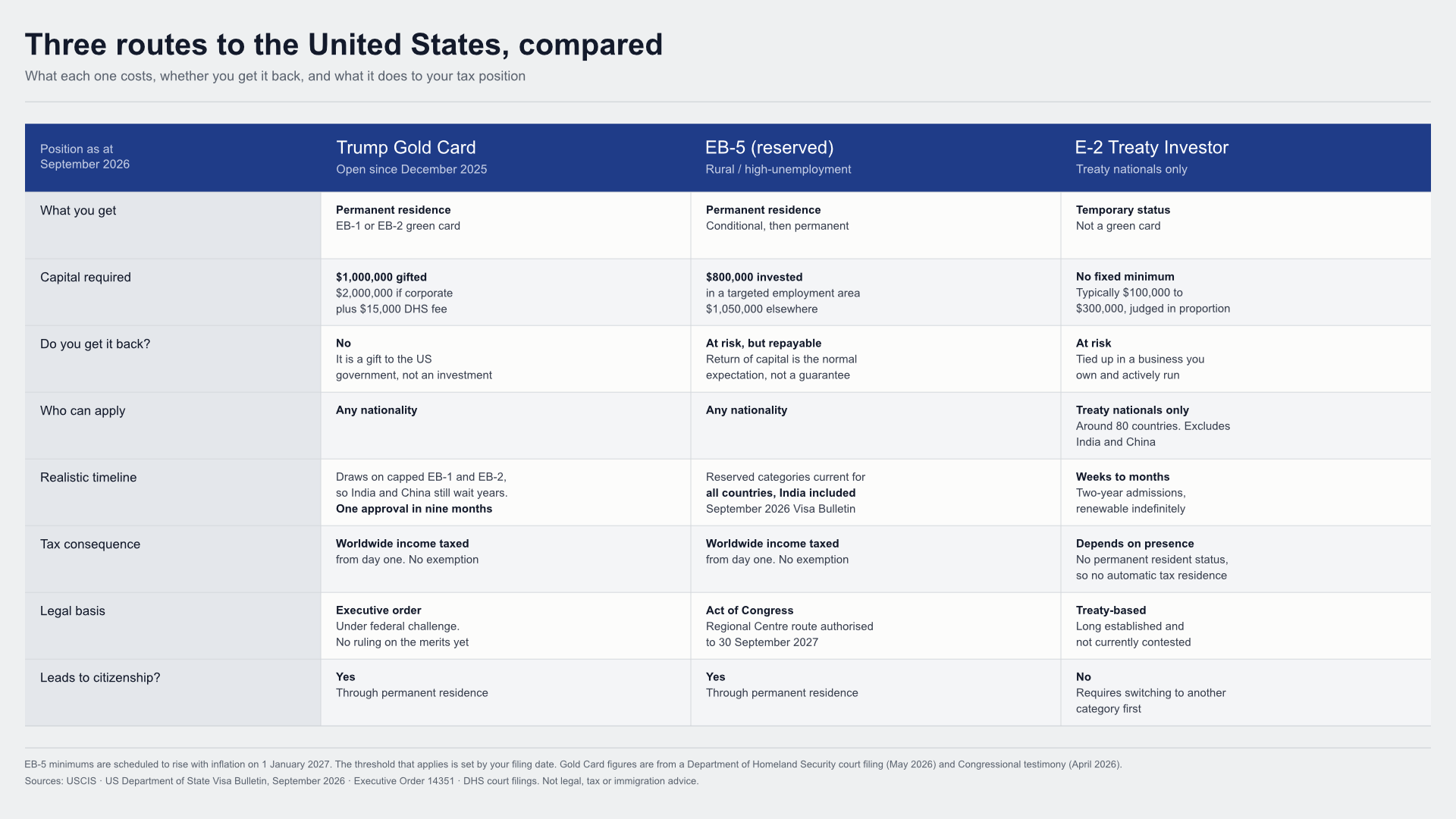
Three routes compared: cost, recoverability, timeline, tax and legal basis. Position as at September 2026.
What people are choosing instead
The best sign of what people are choosing is where the money is going. Immigration lawyers say the problems with the Gold Card have made more people interested in the EB-5 visa, which has seen a jump in applications during the same time.
This makes sense when you look at the numbers. EB-5 requires $800,000 invested in a targeted employment area, instead of $1 million given as a gift. The money is an investment, not a donation.
Congress created the programme, not an executive order. Also, the reserved rural and high-unemployment categories currently have visa numbers available even for Indian nationals, while the unreserved category does not.
It is also why the 30 September 2026 EB-5 grandfathering deadline has mattered so much this year, and why the minimum investment is scheduled to rise on 1 January 2027.
Who the Gold Card genuinely suits
There is a real answer, but it applies to only a small group of people.
The Gold Card makes sense for someone already planning to become a US tax resident, who is not from India or China (where the backlog applies no matter what), values speed and simplicity over cost, and has enough wealth that $1 million is not significant.
For someone moving to the United States anyway and wanting to avoid the burden of proving extraordinary ability, it is a straightforward option.
That is a small group. For everyone else, especially those who want flexibility instead of relocation, EB-5, an E-2 visa (if your nationality qualifies), or a European residency option that keeps your tax situation unchanged are usually better choices.
Where to go from here
The Gold Card is not a scandal or a scam. It is a programme whose economics do not work for most of the people it was meant to help, for reasons like taxes, visa caps, and legal uncertainty that were predictable and are now clear in the numbers.
If you are considering a US immigration path, the important question is not whether the Gold Card is legitimate. Instead, ask which option matches your goals and what each one will cost you in taxes and commitment.
If you want to learn more about US visa options, contact our team.
Ready to get started?
Speak to our friendly team of experts today to learn more or to begin your journey.
Recommended for You

Latvia Golden Visa 2026: What Closed and What's Left
11 November 2026

Greece Golden Visa 2026: The Tiers, the Rental Ban and the 44% Drop
29 October 2026

The Panama Qualified Investor Visa: What Changed and What Didn’t
22 October 2026

Portugal's New Citizenship Rules: Where Things Stand
30 September 2026

EU vs Caribbean Citizenship-by-Investment: What Changed in 2026
23 September 2026

EB-5 Grandfathering: The 30 September Deadline, Explained
16 September 2026

Portugal Golden Visa: Important Update May 2026
27 May 2026

What’s Better: Trump’s Gold Card vs the EB-5 Visa?
16 January 2026

Portugal’s Golden Visa: What Three Years of Change Tell Global Citizens About 2026
17 December 2025
The Trump Gold Card, Nine Months In
Published on: 7th October 2026
At the launch of the Trump Gold Card, the Commerce Secretary predicted 80,000 cards would be issued and over $100 billion in revenue. Just days after applications opened, he announced that $1.3 billion worth of cards had already been sold.
Nine months later, the Department of Homeland Security reported to a federal court that 338 people had requested a Gold Card, 165 had paid the $15,000 processing fee, and 59 petitions had been filed. Only one person had been approved.
These numbers matter because they don't match up. If each card costs $1 million, $1.3 billion would mean about 1,300 buyers. When asked about this difference at a House Appropriations hearing in April, Lutnick did not respond.
This article does not debate whether the Gold Card is a good idea. Instead, it looks at why almost no one has bought one so far, and what these reasons can teach anyone considering a US immigration option.
Where the programme stands
Executive Order 14351 was signed on 19 September 2025. Applications opened on 10 December 2025 through the government's Gold Card website. Full agency guidance followed in March 2026.
The structure:
$1 million contribution from an individual, or $2 million from a corporation sponsoring an employee
$15,000 non-refundable processing fee to DHS
The contribution is paid after approval is confirmed, not upfront
Approved applicants receive an EB-1 or EB-2 immigrant visa and lawful permanent residence
Spouses and dependent children receive derivative green cards
The most recent figures, dated:
Requests submitted: 338 (DHS court filing, May 2026)
$15,000 fees paid: 165 (same filing)
Petitions filed: 59 (same filing)
Approvals: 1 (Lutnick testimony, 23 April 2026; still one as at late July)
Reason one: worldwide taxation
A Gold Card holder becomes a lawful permanent resident, and US permanent residents are taxed on all their worldwide income from the start. There are no exceptions. The programme offers no tax advantage.
For the target audience, this changes everything. A European residency permit costs much less, is usually refundable, and doesn't subject your global income to US taxes. Paying $1 million with no refund and accepting lifetime worldwide taxation is very different from what the marketing suggested.
The administration has suggested a Platinum Card at $5 million, which would reportedly let holders spend up to 270 days a year in the US without paying tax on non-US income. The executive order does not mention this card; it is not accepting applications, and there is only a waiting list. The promised tax treatment would almost certainly need a new law from Congress.
Reason two: you cannot buy a visa number
This is the part that gets the least attention but matters most.
The Gold Card did not create new visas. Approved petitions are handled within the existing EB-1 and EB-2 categories, which have annual per-country limits. Those limits still apply.
For people from countries with long backlogs, especially India and China, the Visa Bulletin wait is still years, no matter how much is paid. Current estimates put the wait between two and twelve years. The government has admitted there is no guaranteed advantage in processing speed.
So an Indian applicant can pay $15,000, get approved, commit $1 million, and still wait in the same line. "Record time," as the official site described it, was never something the programme could deliver for many of the people most likely to want it.
Another complication for these applicants remains. The E-2 treaty investor visa has no per-country cap, but it is only available to nationals of treaty countries. India and China are not on that list. This means the only U.S. visa option without a backlog is unavailable to the people most affected by the backlog.
For Indian or Chinese investors, the real choice is between a Gold Card that does not offer faster processing and EB-5’s reserved categories, which do.
Reason three: the legal position is unresolved
Two federal lawsuits are live in the District of Columbia.
The substantive one was filed on 3 February 2026 by the American Association of University Professors together with six immigrant professionals from Mexico, Colombia, Taiwan and Ghana. It argues the programme is unlawful under the Administrative Procedure Act and the Immigration and Nationality Act, and asks the court to declare it unlawful and halt it.
The challenged part of the programme is especially notable. USCIS has been treating the $1 million payment as clear evidence of eligibility under EB-1A and EB-2 national interest waiver, which are categories Congress created for people with extraordinary or exceptional ability. The plaintiffs say this turns merit-based visas into, in their words, commodities sold to the highest bidder.
The government's response, filed on 28 April 2026, is notable for what it leaves out. It is a standing argument, not a defence of the programme itself. The government says no plaintiff has been displaced, noting that six adjudicators work on the Gold Card while 275 handle regular EB-1 and EB-2 petitions, so the programme causes no delays.
So far, Judge Reyes has issued what practitioners call a non-decision, giving neither side a clear win. No court has ruled on the main issues, and no injunction has been issued. The programme is still operating legally for now. Briefing was expected to continue into late 2026.
A second suit, filed on 13 April 2026 by Democracy Defenders Fund, concerns the agencies' refusal to release documents about the programme's development under the Freedom of Information Act.
Practitioners have pointed out an important risk: early participants could face problems if a court later decides the programme went beyond executive authority. No one knows what would happen if the programme had to be undone, because it has never happened before.
Three routes compared: cost, recoverability, timeline, tax and legal basis. Position as at September 2026.
What people are choosing instead
The best sign of what people are choosing is where the money is going. Immigration lawyers say the problems with the Gold Card have made more people interested in the EB-5 visa, which has seen a jump in applications during the same time.
This makes sense when you look at the numbers. EB-5 requires $800,000 invested in a targeted employment area, instead of $1 million given as a gift. The money is an investment, not a donation.
Congress created the programme, not an executive order. Also, the reserved rural and high-unemployment categories currently have visa numbers available even for Indian nationals, while the unreserved category does not.
It is also why the 30 September 2026 EB-5 grandfathering deadline has mattered so much this year, and why the minimum investment is scheduled to rise on 1 January 2027.
Who the Gold Card genuinely suits
There is a real answer, but it applies to only a small group of people.
The Gold Card makes sense for someone already planning to become a US tax resident, who is not from India or China (where the backlog applies no matter what), values speed and simplicity over cost, and has enough wealth that $1 million is not significant.
For someone moving to the United States anyway and wanting to avoid the burden of proving extraordinary ability, it is a straightforward option.
That is a small group. For everyone else, especially those who want flexibility instead of relocation, EB-5, an E-2 visa (if your nationality qualifies), or a European residency option that keeps your tax situation unchanged are usually better choices.
Where to go from here
The Gold Card is not a scandal or a scam. It is a programme whose economics do not work for most of the people it was meant to help, for reasons like taxes, visa caps, and legal uncertainty that were predictable and are now clear in the numbers.
If you are considering a US immigration path, the important question is not whether the Gold Card is legitimate. Instead, ask which option matches your goals and what each one will cost you in taxes and commitment.
If you want to learn more about US visa options, contact our team.
Need professional financial advice?
We have 18 offices across the globe and we manage over $2billion for our 20,000+ clients