EU vs Caribbean Citizenship-by-Investment: What Changed in 2026
23rd September 2026

If you have researched Caribbean citizenship this year, you have probably come across two main stories.
One story claims the programmes have ended and passport holders will soon lose access to Europe. The other says nothing important has changed and the concerns are overblown.
Neither version is accurate.
Something important did happen in June, and it affects how people should view Caribbean passports. However, no programme has closed, EU visa-free access remains, and nothing will automatically change on 1 June 2028.
Here is what the documents really say, how the Caribbean countries have responded, and what this means for anyone deciding now.
What happened on 25 June 2026
On that date, the European Commission wrote to five Eastern Caribbean governments: Antigua and Barbuda, Dominica, Grenada, Saint Kitts and Nevis, and Saint Lucia. The Commission asked each country to phase out its citizenship-by-investment programme by 1 June 2028.
Magnus Brunner, the European Commissioner for Internal Affairs and Migration, signed the letters.
The letters offered a transition period of about 24 months and suggested interim steps. These include fully excluding individuals subject to EU restrictive measures and strengthening vetting procedures for applicants of all nationalities, with these changes to be in place by September 2026.
Antigua and Barbuda's Office of the Prime Minister released the correspondence on 7 July 2026 and confirmed that all five countries received similar letters.
A note on sourcing: The Commission has not published these letters. The information available comes from the Antiguan government's statement. While this is a credible account of the correspondence, it is not an official EU publication.
Details about the September interim measures come from the Antiguan government's statement and industry reports, not from any direct Commission release. We point this out because it matters when making important decisions, and much of the coverage treats these details as confirmed facts.
What this is not
Precision matters, since the headlines have not been clear.
It is not a visa ban: No suspension of visa-free Schengen access has been imposed on any of the five countries.
It is not a closure order: The Commission has made a formal request. It has no power to abolish another state's citizenship laws.
1 June 2028 is not an automatic cancellation date: It is the date by which the Commission would like the programmes discontinued.
It does not affect existing citizenship: The EU is reviewing its own visa policy, not the legal validity of citizenship granted by sovereign Caribbean states. A Caribbean passport issued today remains a valid passport of that country.
No current application is affected: Programmes are open and processing normally.
Why it still has teeth
This situation differs from previous EU criticism because the law has changed.
In late 2025, the EU updated its Visa Suspension Mechanism, which sets the rules for when the bloc can suspend a third country's visa-free access. The European Parliament approved the reform on 7 October 2025 by a vote of 518 to 96, with 24 abstentions.
The Council followed on 17 November, and the Official Journal published Regulation (EU) 2025/2441 on 10 December 2025. It has been in force since 30 December 2025. The revised rules cover the 61 countries whose nationals currently hold visa-free short-stay access to the Schengen Area.
The main change is that operating an investor citizenship scheme is now, in itself, a ground for suspending visa-free status. Before, the Commission assessed whether a programme was well managed and whether applicants had a "genuine link" to the country.
The new rules focus on whether the scheme exists, not how well it is managed. In its eighth Visa Suspension Mechanism report, adopted on 19 December 2025, the Commission was clear: running these programmes is a reason to suspend visa-free status.
The reform also introduces targeted suspensions for government officials found responsible for human rights abuses or similar violations, rather than relying solely on the previous all-or-nothing approach. This is important to clarify, as it is often misreported: the targeting is aimed at officials, not at people holding a certain type of passport.
The eighth report specifically named all five Eastern Caribbean states. It mentioned about 107,000 passports issued through these five programmes, with 13,113 applications in 2023 and 10,573 in 2024, and very low rejection rates—1.7% in Antigua and Barbuda, 5.3% in Saint Lucia, and 6.5% in Dominica in 2024.
In the annexes, the Commission asked the states to strengthen security checks "pending the discontinuation of those schemes". This shows that better due diligence is seen as a temporary measure, not a permanent fix.
That wording makes the EU’s intentions clearer than any headline could.
The precedents
This is not just a warning, and the record shows it.
Vanuatu
The EU first partially suspended Vanuatu's visa waiver in March 2022 because of its citizenship programme. It then fully suspended it in February 2023. In December 2024, the Council ended the visa exemption completely. Vanuatu was the first country to lose EU visa-free access due to an investor citizenship scheme.
The order of these events is important, but it is often reported incorrectly. The suspension was not imposed, lifted, and then reimposed. Instead, the restrictions increased steadily over about two and a half years, ending with permanent removal.
The United Kingdom
The UK, acting independently of the EU, introduced visa requirements for people from Dominica in July 2023 and Vanuatu in August 2023. The UK said this was due to clear and obvious abuse of investor citizenship schemes.
The UK added Saint Lucia to the list on 5 March 2026. The UK required both a visit visa and a direct airside transit visa, giving travellers with an Electronic Travel Authorisation six weeks, until 16 April 2026, to adjust.
The Home Office gave two reasons for this decision. First, asylum claims rose, with 360 Saint Lucian nationals applying between January 2022 and December 2025. Second, the Home Office considered Saint Lucia's citizenship programme high risk, pointing to more passport applications in 2023 and 2024.
It is important to be clear about how much each reason mattered, since industry coverage has not always been accurate.
The asylum numbers were the main trigger, with the citizenship programme mentioned as well. Saint Lucia sets a real precedent, but it is not a straightforward example of pressure on citizenship-by-investment programmes.
As a result, two of the five states now facing the Commission's request have already lost visa-free access to the UK.
Malta
On 29 April 2025, the Grand Chamber of the Court of Justice of the European Union ruled against Malta in the Commission v Malta (Case C-181/23). The court found that granting citizenship in return for set payments or investments goes against EU law and turns Union citizenship into a commercial product.
The judgment deals with what EU Member States must do under the Treaties. It does not address whether citizenship granted by countries outside the EU is valid, and it does not apply to the Caribbean legally.
The main point here is political: the decision shows how strongly the Commission opposes investor citizenship and that it is ready to take legal action.
Taken together, these examples show that the objection leads to action, although, as Saint Lucia shows, it is not always for citizenship reasons alone.
What the Caribbean has already done
Most coverage stops at the previous section. That produces a misleading picture, because the five states have not been passive.
The March 2024 Memorandum of Agreement
All five countries agreed to set a regional minimum investment of US$200,000, ending the price competition that had been lowering thresholds. They also introduced mandatory interviews for applicants, shared due diligence information between states, and tightened requirements for proving the source of funds.
ECCIRA
In late September 2025, the five governments agreed to create the Eastern Caribbean Citizenship-by-Investment Regulatory Authority, based in Grenada.
The authority is based on a 92-article agreement. It does not replace the national Citizenship-by-Investment Units that handle applications. Instead, it acts as a regional regulator, setting binding rules for due diligence, agent licensing, and minimum investment, and publishing compliance reports.
All five states have passed the necessary legislation. According to the agreement, the authority will start operating 30 days after the fifth ratification is submitted, which was originally expected by early 2026.
As of August 2026, industry reports showed that the authority was still not operational and no official start date had been announced.
The delay should be stated clearly. ECCIRA is the most important structural reform the industry has made, and the five governments have put it at the centre of their case to Brussels.
They named it directly in their July statement as proof of reform. This gap between agreement and operation is now harder to explain, especially with the Commission's assessment due in December.
The joint response
On 10 July 2026, the leaders of all five states met in Roseau, Dominica. Dominica's Prime Minister Roosevelt Skerrit chaired the meeting, and Saint Vincent and the Grenadines also took part.
They released a joint, conciliatory statement highlighting their reform record and calling for a negotiated framework based on fairness and partnership. Notably, the statement did not mention the 2028 date, Schengen, or any interim measures.
There are differences in individual positions. Antigua and Barbuda's Prime Minister Gaston Browne has publicly rejected a unilateral phase-out. He argues that no EU offer so far has been specific, binding, or presented as replacement revenue. At the same time, he has promised to exclude sanctioned individuals and strengthen vetting as a sign of good faith.
This tension is significant. In the five states, revenue from citizenship programmes averages about 6.5% of GDP. For Antigua, it is roughly 15% of government revenue. Brussels is asking these governments to give up a large part of their public finances without any confirmed replacement.
What happens next
The dates that matter:
September 2026: Interim vetting measures expected to be in place: exclusion of EU-sanctioned individuals, reinforced vetting for all nationalities.
24 September 2026: The Prime Ministers of Saint Lucia and Antigua and Barbuda meet Commissioner Brunner in New York. No agreement announced.
End of September 2026: Deadline reported by Antigua's Prime Minister for the five states to say whether they will agree to a phase-out. The states have asked for more time, and for clarity on what conditions would apply. An OECS technical team is to meet the EU, and a delegation to Brussels remains planned.
December 2026: Commission's next Visa Suspension Mechanism report — the first formal assessment of the Caribbean response.
1 June 2028: Date by which the Commission has asked the programmes to be discontinued.
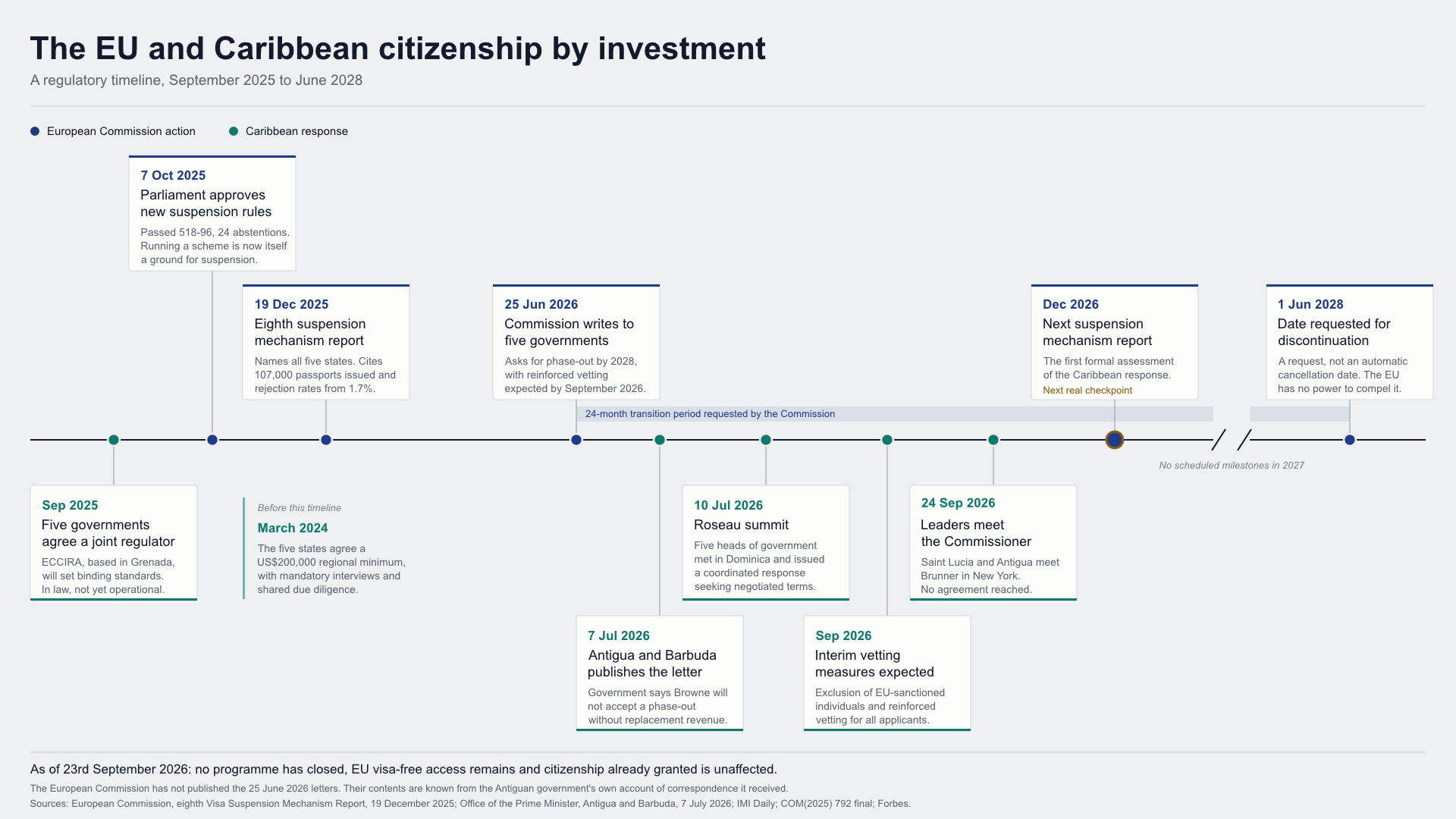
The December 2026 report is the next real checkpoint. If the Commission judges the interim measures insufficient, expect escalation.
The September talks did not produce an agreement. The New York meeting ended without a deal, and the five states have asked Brussels for more time instead of giving an answer. Whether that extension is granted is now the key thing to watch.
What this means if you already hold a Caribbean passport
Your citizenship is not in question here. The EU cannot revoke a nationality that was lawfully granted by a sovereign country, and nothing in the current process is trying to do that.
What could change is one of the benefits of your citizenship: visa-free access to the Schengen Area. It’s important to be realistic about this, since for many people, this was a key reason for getting the passport.
Keep three things in mind, plus a word of caution. If a suspension happens, it would go through a formal process that would take at least several months. The new rules are meant to be temporary at first, not permanent. Also, the report due in December 2026 is just an assessment, not a final decision.
The caution is Vanuatu. Its experience does not support the hope that a suspension, once imposed, is readily reversed: there, a partial suspension escalated to a full one and then to permanent removal. We would rather say that plainly than offer reassurance the record does not carry.
The record offers some reassurance. The UK and the EU make their own decisions. For example, when the UK removed Saint Lucian visa-free access in March 2026, Schengen access stayed the same, as did CARICOM free movement and Saint Lucia’s other visa-free destinations. Losing one doesn't mean you lose the others, but it does mean decisions can come from different places.
If Schengen access matters for your plans and you only have a Caribbean passport, now is a good time to consider whether another option, like an EU residency permit, might offer more security. There’s no need to rush or worry, but it’s wise to consider your options rather than make assumptions.
What this means if you are deciding now
Caribbean citizenship offers unique advantages. Processing usually takes months, not years. You do not need to relocate; it is easy to include family members, and the starting cost, from US$200,000 before fees, is lower than that of comparable programmes.
If your main goal is to get a second nationality with wide travel options quickly and without moving, this remains a strong choice.
Recent reforms have made the process a bit more complex. All five programmes now require applicant interviews and biometric data. Antigua and Barbuda also asks for a five-day visit within the first five years.
Visa-free access to the Schengen Area is now less certain. This should affect how you consider the programme, but it does not mean you should rule it out.
Three practical suggestions:
Be specific about what you actually need
If you want a second passport mainly for security, inheritance, or business, the EU part is less important than you might think. However, if easy travel within Europe is your priority, then the EU question becomes more important.
Consider the comparison set honestly
You now have more options. Some programmes, such as those in Nauru and São Tomé and Príncipe, are not part of the EU visa-waiver system and are not affected by these changes. However, they have their own travel and development limits. European residency-by-investment options, like those in Greece, address the Schengen issue directly, but they tend to cost more and require extra steps.
Watch December rather than 2028
The Commission’s next report will provide more clarity. If you decide before it comes out, you might not have all the information. You do not have to wait, but it is wise to keep your plans flexible.
Where to go from here
This is an ongoing negotiation with a set timeline and an uncertain result. That is why it is the kind of decision where getting advice is better than just reading about it.
If you are considering a Caribbean programme now, the important question is not just whether it is safe. Instead, you should ask what problem you want to solve and which options will give you a lasting solution. That is where we would begin.
Frequently asked questions
Will Caribbean passport holders lose Schengen access?
Not at present, and no decision has been taken. The revised Visa Suspension Mechanism makes it possible, and the Commission's December 2026 report is the next formal assessment point.
Are the Caribbean programmes closing in 2028?
The European Commission has asked the five states to phase them out by 1 June 2028. It cannot compel them to, and the governments have not agreed. Negotiations are due to begin in Brussels at the end of September 2026.
Does this affect citizenship already granted?
No. The EU is reviewing its own visa policy. Citizenship lawfully granted by a sovereign state remains valid.
Can I still apply?
Yes. All five programmes are open and processing applications normally, at a regional minimum of US$200,000 before government, due diligence and professional fees.
This article is for information only. It is not legal, tax, immigration or investment advice, and it is not an offer or a financial promotion. Programme rules, investment thresholds and visa arrangements change frequently — verify the current position and take professional advice before acting.
Ready to get started?
Speak to our friendly team of experts today to learn more or to begin your journey.
Recommended for You

The Trump Gold Card, Nine Months In
7 October 2026

Portugal's New Citizenship Rules: Where Things Stand
30 September 2026

EB-5 Grandfathering: The 30 September Deadline, Explained
16 September 2026

Latvia's Door Is Closing: The Question Is Whether You'll Walk Through It First
14 August 2026

Portugal Golden Visa: Important Update May 2026
27 May 2026

What’s Better: Trump’s Gold Card vs the EB-5 Visa?
16 January 2026

Portugal’s Golden Visa: What Three Years of Change Tell Global Citizens About 2026
17 December 2025

How Do H-1B Visa Changes Affect the EB-3 & EB-5 Visas?
26 September 2025

Double Tax Agreements: What are They and How Do They Work?
10 July 2025
EU vs Caribbean Citizenship-by-Investment: What Changed in 2026
Published on: 23rd September 2026
If you have researched Caribbean citizenship this year, you have probably come across two main stories.
One story claims the programmes have ended and passport holders will soon lose access to Europe. The other says nothing important has changed and the concerns are overblown.
Neither version is accurate.
Something important did happen in June, and it affects how people should view Caribbean passports. However, no programme has closed, EU visa-free access remains, and nothing will automatically change on 1 June 2028.
Here is what the documents really say, how the Caribbean countries have responded, and what this means for anyone deciding now.
What happened on 25 June 2026
On that date, the European Commission wrote to five Eastern Caribbean governments: Antigua and Barbuda, Dominica, Grenada, Saint Kitts and Nevis, and Saint Lucia. The Commission asked each country to phase out its citizenship-by-investment programme by 1 June 2028.
Magnus Brunner, the European Commissioner for Internal Affairs and Migration, signed the letters.
The letters offered a transition period of about 24 months and suggested interim steps. These include fully excluding individuals subject to EU restrictive measures and strengthening vetting procedures for applicants of all nationalities, with these changes to be in place by September 2026.
Antigua and Barbuda's Office of the Prime Minister released the correspondence on 7 July 2026 and confirmed that all five countries received similar letters.
A note on sourcing: The Commission has not published these letters. The information available comes from the Antiguan government's statement. While this is a credible account of the correspondence, it is not an official EU publication.
Details about the September interim measures come from the Antiguan government's statement and industry reports, not from any direct Commission release. We point this out because it matters when making important decisions, and much of the coverage treats these details as confirmed facts.
What this is not
Precision matters, since the headlines have not been clear.
It is not a visa ban: No suspension of visa-free Schengen access has been imposed on any of the five countries.
It is not a closure order: The Commission has made a formal request. It has no power to abolish another state's citizenship laws.
1 June 2028 is not an automatic cancellation date: It is the date by which the Commission would like the programmes discontinued.
It does not affect existing citizenship: The EU is reviewing its own visa policy, not the legal validity of citizenship granted by sovereign Caribbean states. A Caribbean passport issued today remains a valid passport of that country.
No current application is affected: Programmes are open and processing normally.
Why it still has teeth
This situation differs from previous EU criticism because the law has changed.
In late 2025, the EU updated its Visa Suspension Mechanism, which sets the rules for when the bloc can suspend a third country's visa-free access. The European Parliament approved the reform on 7 October 2025 by a vote of 518 to 96, with 24 abstentions.
The Council followed on 17 November, and the Official Journal published Regulation (EU) 2025/2441 on 10 December 2025. It has been in force since 30 December 2025. The revised rules cover the 61 countries whose nationals currently hold visa-free short-stay access to the Schengen Area.
The main change is that operating an investor citizenship scheme is now, in itself, a ground for suspending visa-free status. Before, the Commission assessed whether a programme was well managed and whether applicants had a "genuine link" to the country.
The new rules focus on whether the scheme exists, not how well it is managed. In its eighth Visa Suspension Mechanism report, adopted on 19 December 2025, the Commission was clear: running these programmes is a reason to suspend visa-free status.
The reform also introduces targeted suspensions for government officials found responsible for human rights abuses or similar violations, rather than relying solely on the previous all-or-nothing approach. This is important to clarify, as it is often misreported: the targeting is aimed at officials, not at people holding a certain type of passport.
The eighth report specifically named all five Eastern Caribbean states. It mentioned about 107,000 passports issued through these five programmes, with 13,113 applications in 2023 and 10,573 in 2024, and very low rejection rates—1.7% in Antigua and Barbuda, 5.3% in Saint Lucia, and 6.5% in Dominica in 2024.
In the annexes, the Commission asked the states to strengthen security checks "pending the discontinuation of those schemes". This shows that better due diligence is seen as a temporary measure, not a permanent fix.
That wording makes the EU’s intentions clearer than any headline could.
The precedents
This is not just a warning, and the record shows it.
Vanuatu
The EU first partially suspended Vanuatu's visa waiver in March 2022 because of its citizenship programme. It then fully suspended it in February 2023. In December 2024, the Council ended the visa exemption completely. Vanuatu was the first country to lose EU visa-free access due to an investor citizenship scheme.
The order of these events is important, but it is often reported incorrectly. The suspension was not imposed, lifted, and then reimposed. Instead, the restrictions increased steadily over about two and a half years, ending with permanent removal.
The United Kingdom
The UK, acting independently of the EU, introduced visa requirements for people from Dominica in July 2023 and Vanuatu in August 2023. The UK said this was due to clear and obvious abuse of investor citizenship schemes.
The UK added Saint Lucia to the list on 5 March 2026. The UK required both a visit visa and a direct airside transit visa, giving travellers with an Electronic Travel Authorisation six weeks, until 16 April 2026, to adjust.
The Home Office gave two reasons for this decision. First, asylum claims rose, with 360 Saint Lucian nationals applying between January 2022 and December 2025. Second, the Home Office considered Saint Lucia's citizenship programme high risk, pointing to more passport applications in 2023 and 2024.
It is important to be clear about how much each reason mattered, since industry coverage has not always been accurate.
The asylum numbers were the main trigger, with the citizenship programme mentioned as well. Saint Lucia sets a real precedent, but it is not a straightforward example of pressure on citizenship-by-investment programmes.
As a result, two of the five states now facing the Commission's request have already lost visa-free access to the UK.
Malta
On 29 April 2025, the Grand Chamber of the Court of Justice of the European Union ruled against Malta in the Commission v Malta (Case C-181/23). The court found that granting citizenship in return for set payments or investments goes against EU law and turns Union citizenship into a commercial product.
The judgment deals with what EU Member States must do under the Treaties. It does not address whether citizenship granted by countries outside the EU is valid, and it does not apply to the Caribbean legally.
The main point here is political: the decision shows how strongly the Commission opposes investor citizenship and that it is ready to take legal action.
Taken together, these examples show that the objection leads to action, although, as Saint Lucia shows, it is not always for citizenship reasons alone.
What the Caribbean has already done
Most coverage stops at the previous section. That produces a misleading picture, because the five states have not been passive.
The March 2024 Memorandum of Agreement
All five countries agreed to set a regional minimum investment of US$200,000, ending the price competition that had been lowering thresholds. They also introduced mandatory interviews for applicants, shared due diligence information between states, and tightened requirements for proving the source of funds.
ECCIRA
In late September 2025, the five governments agreed to create the Eastern Caribbean Citizenship-by-Investment Regulatory Authority, based in Grenada.
The authority is based on a 92-article agreement. It does not replace the national Citizenship-by-Investment Units that handle applications. Instead, it acts as a regional regulator, setting binding rules for due diligence, agent licensing, and minimum investment, and publishing compliance reports.
All five states have passed the necessary legislation. According to the agreement, the authority will start operating 30 days after the fifth ratification is submitted, which was originally expected by early 2026.
As of August 2026, industry reports showed that the authority was still not operational and no official start date had been announced.
The delay should be stated clearly. ECCIRA is the most important structural reform the industry has made, and the five governments have put it at the centre of their case to Brussels.
They named it directly in their July statement as proof of reform. This gap between agreement and operation is now harder to explain, especially with the Commission's assessment due in December.
The joint response
On 10 July 2026, the leaders of all five states met in Roseau, Dominica. Dominica's Prime Minister Roosevelt Skerrit chaired the meeting, and Saint Vincent and the Grenadines also took part.
They released a joint, conciliatory statement highlighting their reform record and calling for a negotiated framework based on fairness and partnership. Notably, the statement did not mention the 2028 date, Schengen, or any interim measures.
There are differences in individual positions. Antigua and Barbuda's Prime Minister Gaston Browne has publicly rejected a unilateral phase-out. He argues that no EU offer so far has been specific, binding, or presented as replacement revenue. At the same time, he has promised to exclude sanctioned individuals and strengthen vetting as a sign of good faith.
This tension is significant. In the five states, revenue from citizenship programmes averages about 6.5% of GDP. For Antigua, it is roughly 15% of government revenue. Brussels is asking these governments to give up a large part of their public finances without any confirmed replacement.
What happens next
The dates that matter:
September 2026: Interim vetting measures expected to be in place: exclusion of EU-sanctioned individuals, reinforced vetting for all nationalities.
24 September 2026: The Prime Ministers of Saint Lucia and Antigua and Barbuda meet Commissioner Brunner in New York. No agreement announced.
End of September 2026: Deadline reported by Antigua's Prime Minister for the five states to say whether they will agree to a phase-out. The states have asked for more time, and for clarity on what conditions would apply. An OECS technical team is to meet the EU, and a delegation to Brussels remains planned.
December 2026: Commission's next Visa Suspension Mechanism report — the first formal assessment of the Caribbean response.
1 June 2028: Date by which the Commission has asked the programmes to be discontinued.
The December 2026 report is the next real checkpoint. If the Commission judges the interim measures insufficient, expect escalation.
The September talks did not produce an agreement. The New York meeting ended without a deal, and the five states have asked Brussels for more time instead of giving an answer. Whether that extension is granted is now the key thing to watch.
What this means if you already hold a Caribbean passport
Your citizenship is not in question here. The EU cannot revoke a nationality that was lawfully granted by a sovereign country, and nothing in the current process is trying to do that.
What could change is one of the benefits of your citizenship: visa-free access to the Schengen Area. It’s important to be realistic about this, since for many people, this was a key reason for getting the passport.
Keep three things in mind, plus a word of caution. If a suspension happens, it would go through a formal process that would take at least several months. The new rules are meant to be temporary at first, not permanent. Also, the report due in December 2026 is just an assessment, not a final decision.
The caution is Vanuatu. Its experience does not support the hope that a suspension, once imposed, is readily reversed: there, a partial suspension escalated to a full one and then to permanent removal. We would rather say that plainly than offer reassurance the record does not carry.
The record offers some reassurance. The UK and the EU make their own decisions. For example, when the UK removed Saint Lucian visa-free access in March 2026, Schengen access stayed the same, as did CARICOM free movement and Saint Lucia’s other visa-free destinations. Losing one doesn't mean you lose the others, but it does mean decisions can come from different places.
If Schengen access matters for your plans and you only have a Caribbean passport, now is a good time to consider whether another option, like an EU residency permit, might offer more security. There’s no need to rush or worry, but it’s wise to consider your options rather than make assumptions.
What this means if you are deciding now
Caribbean citizenship offers unique advantages. Processing usually takes months, not years. You do not need to relocate; it is easy to include family members, and the starting cost, from US$200,000 before fees, is lower than that of comparable programmes.
If your main goal is to get a second nationality with wide travel options quickly and without moving, this remains a strong choice.
Recent reforms have made the process a bit more complex. All five programmes now require applicant interviews and biometric data. Antigua and Barbuda also asks for a five-day visit within the first five years.
Visa-free access to the Schengen Area is now less certain. This should affect how you consider the programme, but it does not mean you should rule it out.
Three practical suggestions:
Be specific about what you actually need
If you want a second passport mainly for security, inheritance, or business, the EU part is less important than you might think. However, if easy travel within Europe is your priority, then the EU question becomes more important.
Consider the comparison set honestly
You now have more options. Some programmes, such as those in Nauru and São Tomé and Príncipe, are not part of the EU visa-waiver system and are not affected by these changes. However, they have their own travel and development limits. European residency-by-investment options, like those in Greece, address the Schengen issue directly, but they tend to cost more and require extra steps.
Watch December rather than 2028
The Commission’s next report will provide more clarity. If you decide before it comes out, you might not have all the information. You do not have to wait, but it is wise to keep your plans flexible.
Where to go from here
This is an ongoing negotiation with a set timeline and an uncertain result. That is why it is the kind of decision where getting advice is better than just reading about it.
If you are considering a Caribbean programme now, the important question is not just whether it is safe. Instead, you should ask what problem you want to solve and which options will give you a lasting solution. That is where we would begin.
Frequently asked questions
Will Caribbean passport holders lose Schengen access?
Not at present, and no decision has been taken. The revised Visa Suspension Mechanism makes it possible, and the Commission's December 2026 report is the next formal assessment point.
Are the Caribbean programmes closing in 2028?
The European Commission has asked the five states to phase them out by 1 June 2028. It cannot compel them to, and the governments have not agreed. Negotiations are due to begin in Brussels at the end of September 2026.
Does this affect citizenship already granted?
No. The EU is reviewing its own visa policy. Citizenship lawfully granted by a sovereign state remains valid.
Can I still apply?
Yes. All five programmes are open and processing applications normally, at a regional minimum of US$200,000 before government, due diligence and professional fees.
This article is for information only. It is not legal, tax, immigration or investment advice, and it is not an offer or a financial promotion. Programme rules, investment thresholds and visa arrangements change frequently — verify the current position and take professional advice before acting.
Need professional financial advice?
We have 18 offices across the globe and we manage over $2billion for our 20,000+ clients